A BPD splitting test is not a diagnosis. It is a structured way to notice whether black-and-white thinking, sudden idealization, sudden devaluation, or relationship panic may be part of a broader borderline personality disorder pattern.
If you searched for a "BPD splitting test," you may be trying to understand why your view of someone can flip so sharply. One moment a partner, friend, parent, therapist, or coworker may feel safe and caring. After a painful comment, delayed reply, boundary, or disappointment, the same person may suddenly feel cold, unsafe, fake, or completely against you. This guide helps you reflect on that pattern without turning one emotional reaction into a label.
In this guide
Short answer: BPD-related splitting is most concerning when your view of a person, yourself, or a relationship shifts rapidly from all-good to all-bad, especially after perceived rejection, shame, criticism, or abandonment fear. It becomes more important to screen broadly when the pattern repeats across relationships and appears with mood swings, impulsive behavior, anger, emptiness, identity confusion, dissociation, or self-harm risk.
What Splitting Can Look Like in BPD
Splitting is a common everyday word for a black-and-white thinking pattern. In BPD-related conversations, people often use it to describe rapid shifts between idealizing and devaluing someone. The National Institute of Mental Health describes borderline personality disorder as involving ongoing instability in moods, behavior, self-image, and functioning. Splitting matters because it can sit inside that wider instability, especially in close relationships.
For example, a delayed text may feel like proof that someone no longer cares. A therapist's boundary may feel like rejection. A friend's neutral tone may seem like hidden anger. A partner asking for space may feel like abandonment. In the moment, the brain may simplify the person into one painful meaning: "They never cared," "I was stupid to trust them," "They are unsafe," or "I have ruined everything."
The pattern can also point inward. You may see yourself as good, lovable, and capable while reassured, then suddenly feel worthless, toxic, or impossible to love after conflict. The key question is not whether you ever think in extremes. Everyone can do that under stress. The useful question is whether the shifts are frequent, intense, relationship-linked, hard to slow down, and followed by impulsive actions or painful repair cycles.
BPD Splitting Test: 12 Self-Reflection Questions
Use these questions as a self-reflection checklist, not a score. Answer based on repeated patterns over months or years, especially in close relationships. If the answer is "yes" only during one recent crisis, also consider grief, sleep loss, trauma reminders, burnout, substance use, or ordinary conflict before assuming BPD.
How to interpret your answers
If several questions fit, avoid using this page as proof that you have BPD. A better next step is to document examples and compare the pattern with a broader Comprehensive BPD Test. If the experience is mostly internal, masked, or followed by self-blame rather than visible conflict, the Quiet BPD Test may fit your search intent better. If intense stress is followed by numbness, unreality, or feeling outside your body, use the dissociation in BPD guide to track triggers and grounding steps. If the shift centers on one emotionally important person, the BPD favorite person test guide can help you track reassurance loops and boundary panic. If the pattern is mixed with irritability, protest, resentment, and relationship testing, compare it with the Petulant BPD Test guide.
A Trigger-to-Repair Map for Splitting
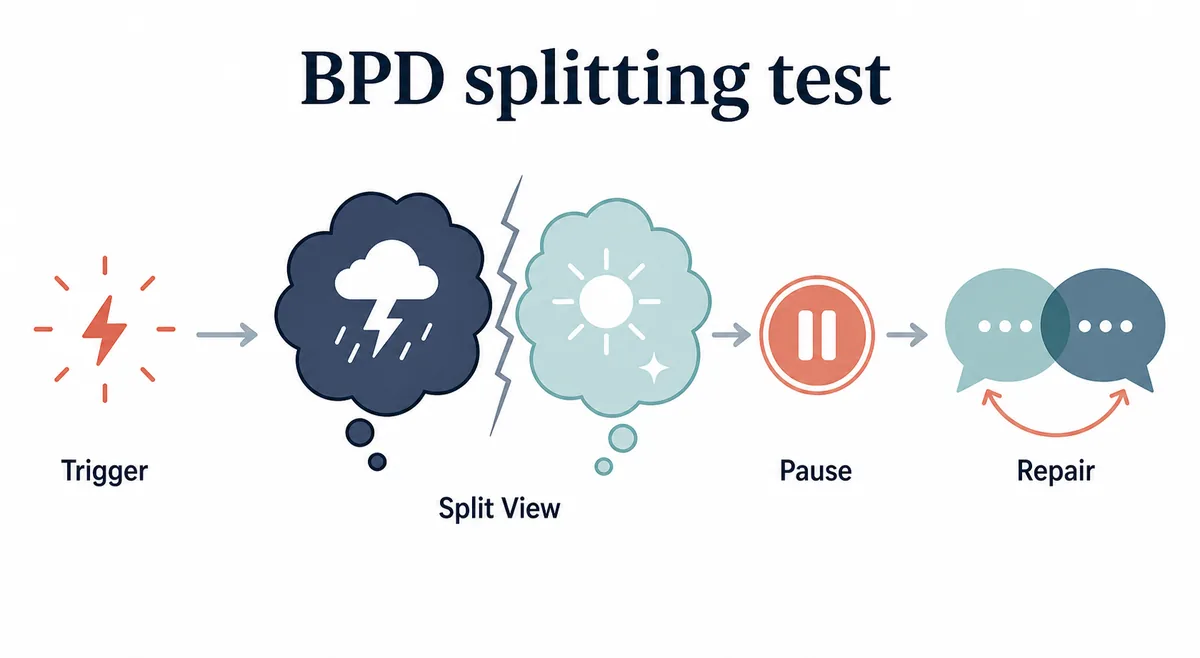
A useful BPD splitting test should help you slow the pattern down. The goal is not to judge the emotion. The goal is to separate the event, the meaning your mind attached to it, the urge that followed, and the repair step that protects safety and trust.
| Step to track | Example | Reflection question |
|---|---|---|
| Trigger | A delayed reply, criticism, changed plan, boundary, facial expression, or feeling excluded | What happened before my view flipped? |
| Split view | "They never cared," "I cannot trust anyone," "I am disgusting," or "This relationship is over" | What all-good or all-bad conclusion did my mind jump to? |
| Body alarm | Heat, shaking, tight chest, racing thoughts, numbness, tunnel vision, or urgent energy | How did my body signal threat? |
| Action urge | Block, accuse, test, leave, beg, self-punish, drink, drive, or send a long message | What did the urge promise to fix immediately? |
| Repair step | Pause, name the trigger, ask for clarification, apologize for behavior, make a safety plan | What would protect both my dignity and the relationship? |
Try writing one recent example in this format: "When ___ happened, I believed ___. My body felt ___. I wanted to ___. The cost was ___. A safer repair step would be ___." Specific examples are more useful than broad labels when you talk with a therapist or compare your pattern with other BPD symptoms.
BPD Splitting vs Other Explanations
Splitting-like thinking can happen outside BPD. Trauma responses can make neutral cues feel dangerous. Anxiety can turn uncertainty into threat. Depression can make self-judgment feel absolute. ADHD-related emotional impulsivity can make reactions fast. Relationship abuse can make distrust realistic rather than distorted. Sleep deprivation, substance use, grief, and chronic stress can also narrow perspective.
BPD becomes a stronger question when the splitting appears alongside the broader symptom pattern. The Mayo Clinic describes BPD as involving relationships, self-image, emotions, impulsiveness, and fear of abandonment. That means a splitting-only checklist is too narrow. Clinicians look for repeated patterns, context, duration, safety risk, impairment, and other possible explanations.
It is also worth comparing splitting with mood-episode questions. If your view of people changes mainly during longer periods of unusually high energy, decreased need for sleep, increased activity, or severe depression, read our BPD or bipolar quiz-style guide and talk with a qualified professional. If the shifts are mostly fast, relationship-triggered, and tied to abandonment panic, BPD screening may be more relevant.
Need a broader view than splitting alone?
Use a full assessment when splitting appears with abandonment fear, emotional swings, impulsive behavior, emptiness, anger, or dissociation.
Take the Comprehensive BPD TestWhat to Do With Your BPD Splitting Test Answers
The goal is not to prove a diagnosis by yourself. The goal is to notice the pattern early enough to reduce harm. NICE guidance for borderline personality disorder emphasizes structured care for distress, anxiety, worthlessness, anger, and relationship difficulties. A self-reflection page can help you organize examples, but it cannot replace assessment or support.
- Track three examples: Choose recent situations where your view of someone or yourself flipped sharply.
- Name the trigger: Was the shift tied to rejection, criticism, uncertainty, shame, jealousy, or fear of abandonment?
- Delay irreversible actions: Avoid break-up messages, blocking, unsafe driving, substance use, or self-punishment while the alarm is high.
- Use both-and language: Try "I feel hurt and this person may still care" or "I made a mistake and I am still responsible for repair."
- Screen broadly: Compare your answers with the BPD Symptoms Test guide or a full assessment.
- Bring examples to care: A therapist can help compare BPD, trauma, bipolar disorder, depression, ADHD, substance use, relationship safety, and other explanations.
If splitting is linked to self-harm urges, suicidal thoughts, threats, violence, stalking, unsafe driving, or fear that someone may be hurt, use emergency or crisis support now. In the United States, call or text 988 for the Suicide & Crisis Lifeline, or call 911 for immediate danger. Outside the United States, use your local emergency number or crisis service.
FAQ
Is there a clinical BPD splitting test?
No standalone clinical test diagnoses BPD from splitting alone. A BPD splitting test should be treated as self-reflection that helps you decide whether broader screening or professional assessment is appropriate.
What does BPD splitting feel like?
It may feel like a sudden emotional certainty that someone is all good or all bad, safe or unsafe, loving or rejecting. The shift can feel urgent and convincing in the moment, then confusing or painful afterward.
Can splitting happen without BPD?
Yes. Trauma, anxiety, depression, attachment insecurity, severe stress, sleep loss, substance use, and unsafe relationships can all create black-and-white thinking. Context and the broader pattern matter.
Is splitting the same as anger?
No. Splitting is a shift in perception or meaning. Anger can come with it, but splitting can also show up as panic, numbness, shame, withdrawal, idealization, or self-blame.
When should I seek professional help?
Seek support if splitting repeatedly damages relationships, work, school, safety, or self-respect, or if it appears with self-harm risk, suicidal thoughts, impulsive behavior, dissociation, or intense abandonment fear.
Medical Disclaimer
This article is for educational purposes only and does not provide a diagnosis, treatment plan, or emergency support. If you are in immediate danger or may harm yourself or someone else, call emergency services or a local crisis hotline now.