Table of Contents
Quick Answer: Is There a Real 4 Types of BPD Test?
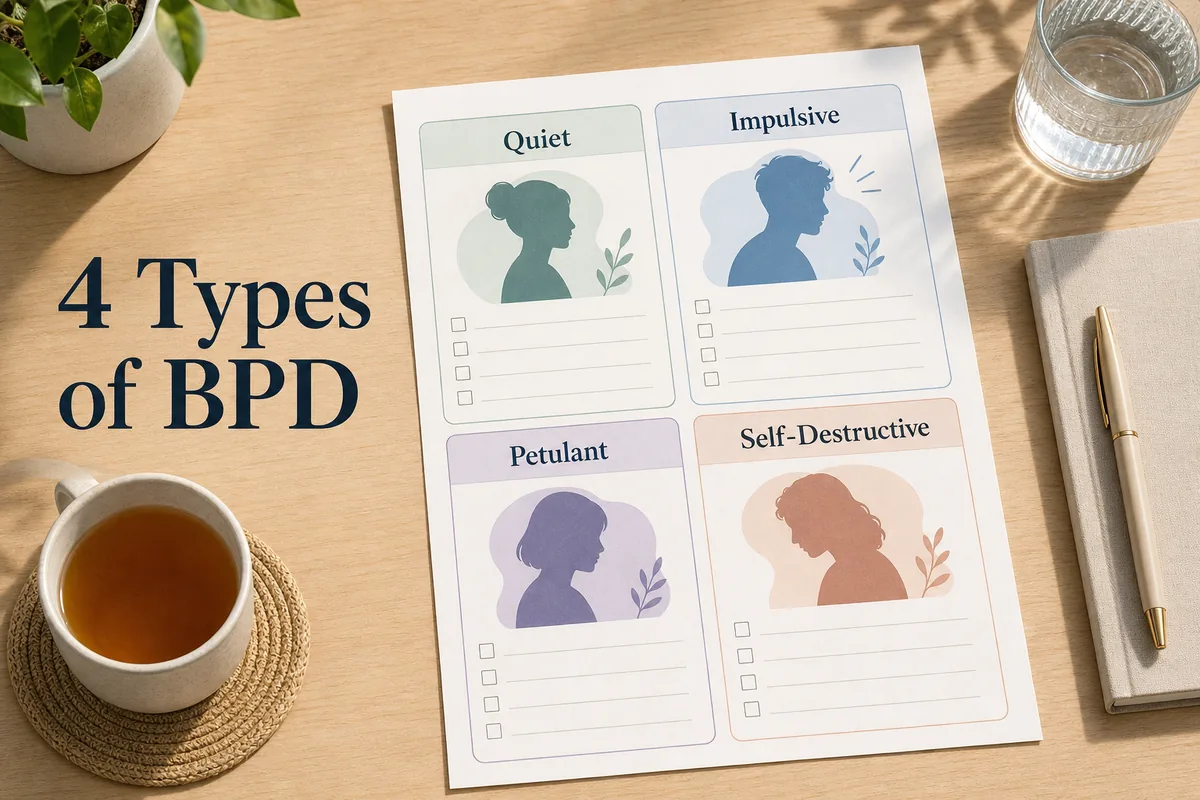
A 4 types of BPD test can help you reflect on patterns such as quiet, impulsive, petulant, or self-destructive BPD, but these are not separate official diagnoses. They are informal descriptions people use to make sense of how borderline personality disorder traits may show up in daily life.
If you searched for a BPD subtypes test or a "what type of BPD do I have quiz," the safest answer is this: use subtype language as a starting point for self-awareness, not as a final label. A subtype result cannot tell you whether you have borderline personality disorder. A broader BPD screening and, when needed, a professional evaluation are more useful because BPD is diagnosed by looking at repeated patterns across emotions, relationships, identity, behavior, safety, and functioning.
Use this page for pattern recognition, not scoring. For interactive questions, try the comprehensive BPD screening, then return to compare patterns.
Before using subtype labels
NIMH describes BPD as ongoing instability in mood, behavior, self-image, and functioning, while Mayo Clinic explains that diagnosis requires a detailed evaluation. An online quiz can organize observations, not replace assessment.
BPD Subtypes Comparison Table
The table below summarizes the common four-type framework. Treat it as an educational map, not a diagnostic checklist. Many people relate to more than one column, and patterns can shift with stress, age, treatment, relationships, substance use, trauma triggers, or current support.
| Informal subtype | Common pattern | What it may feel like internally | Helpful next step |
|---|---|---|---|
| Discouraged or Quiet BPD | Distress is hidden, masked, or turned inward. | "I look fine, but I am blaming myself and spiraling privately." | Use a Quiet BPD Test to explore internalized symptoms. |
| Impulsive BPD | Emotional intensity may lead to risky or fast decisions. | "I need relief now, even if I regret it later." | Track triggers, urges, and consequences before taking a broader BPD screening. |
| Petulant BPD | Fear and hurt may come out through anger, resentment, or relationship testing. | "I need reassurance, but I feel angry that I need it." | Read the Petulant BPD Test guide. |
| Self-Destructive BPD | Shame, emptiness, or abandonment fear may lead to self-sabotage or self-harm risk. | "I feel like I deserve pain or I cannot stop making things worse." | Prioritize safety planning and professional support if risk is present. |
Discouraged or Quiet BPD
Discouraged BPD is often discussed alongside quiet BPD. The central idea is that distress is directed inward rather than expressed loudly. Someone may appear calm, helpful, successful, or easygoing while privately feeling rejected, ashamed, empty, or terrified of being too much. This is why some people search for a discouraged BPD test after realizing that classic descriptions of visible anger or conflict do not fully match them.
Quiet BPD patterns can include people-pleasing, over-apologizing, emotional suppression, withdrawal after perceived rejection, hidden self-criticism, and intense private spirals. A person may avoid asking for reassurance because needing help feels humiliating. Instead, they may disappear, blame themselves, overwork, or punish themselves silently. Our quiet BPD symptoms guide focuses on this internalized pattern in more detail.
A quiet presentation can be missed when life looks functional from the outside. Focus on whether distress is intense, repeated, hard to regulate, and connected to relationship fears, identity confusion, emptiness, self-harm thoughts, or dissociation.
Impulsive BPD
An impulsive BPD test usually attracts people who notice a pattern of fast decisions during emotional spikes. Impulsivity can show up as reckless spending, unsafe sex, substance use, binge eating, dangerous driving, sudden quitting, intense messaging, or choices that create immediate relief but later regret. The behavior is not random; it often functions as an attempt to escape intolerable emotion, emptiness, shame, boredom, or abandonment panic.
Impulsive patterns become more concerning when they repeat across situations and create real consequences. One impulsive weekend does not equal BPD. A long-term pattern of emotional triggers followed by risky behavior, regret, repair attempts, and another cycle is more important to examine. A broader BPD symptoms test guide can help you compare impulsivity with other symptom areas rather than focusing on one behavior.
Track the trigger, emotion, urge, action, short-term relief, and long-term cost. That record is more useful than a subtype label and can help a clinician compare BPD-related impulsivity with ADHD, bipolar episodes, substance use, trauma, or other explanations.
Petulant BPD
Petulant BPD is an informal label for a pattern where hurt, fear, and insecurity may come out as irritability, resentment, protest, or relationship testing. Someone may deeply want closeness but feel angry about needing reassurance. A delayed reply, changed plan, or neutral tone may feel like rejection, and the response may include accusation, sarcasm, shutting down, ultimatums, or attempts to make the other person prove they care.
This does not mean the person is simply being difficult. In many cases, anger is protecting a more vulnerable feeling: fear of abandonment, shame, loneliness, or panic. The problem is that testing and protest can create distance, which then increases the fear that started the cycle. That is why a petulant BPD test should focus less on assigning a label and more on identifying repeated loops that damage trust.
For more examples, compare it with the dedicated Petulant BPD Test guide, which covers reassurance loops and anger after perceived rejection.
Self-Destructive BPD
A self-destructive BPD test is usually searched by people who notice self-sabotage, self-punishment, or urges to harm themselves when overwhelmed. This can include staying in harmful situations, undermining success, pushing away support, escalating conflict, misusing substances, reckless behavior, or self-harm. The pattern may be connected to shame, emptiness, dissociation, abandonment fear, or a belief that pain is deserved.
This category needs special care because it can overlap with urgent safety concerns. If you are thinking about harming yourself, feel unable to stay safe, or may harm someone else, do not wait for an online BPD subtype test. Use emergency services, a local crisis line, or immediate professional support. Online education is too slow for an active crisis.
When there is no immediate danger, note what comes before the urge—conflict, shame, loneliness, substance use, or feeling unreal—and what helps even slightly, such as contacting support, delaying action, or using a safety plan.
Self-Reflection Questions: Which Pattern Sounds Familiar?
These questions are not a diagnosis and should not be scored as a formal BPD subtypes test. Use them to decide which existing resource or professional conversation may be the best next step.
Quiet or discouraged pattern
- Do I hide intense distress because I do not want to seem needy, dramatic, or difficult?
- Do I blame myself first when I feel rejected, even when the situation is unclear?
- Do I withdraw, people-please, or punish myself silently instead of asking for help?
Impulsive pattern
- Do I make fast decisions during emotional spikes that I later regret?
- Do I use spending, sex, substances, food, conflict, or sudden exits to escape distress?
- Do the same impulsive cycles repeat after relationship stress or shame?
Petulant pattern
- Do I test people to see whether they will reassure, chase, or choose me?
- Do I become angry when I actually feel scared, unwanted, or embarrassed?
- Do I regret accusations, ultimatums, or cold behavior after my emotions settle?
Self-destructive pattern
- Do I sabotage good things when I feel ashamed, empty, abandoned, or exposed?
- Do I feel pulled toward self-punishment when emotions become too intense?
- Do I need a safety plan or professional support to manage harmful urges?
Use subtypes as a starting point, then screen broadly
A full BPD screening looks across the major symptom areas instead of relying on one informal type. This is the safest next step if you searched for a BPD subtypes test, a 4 types of BPD test, or a "what type of BPD do I have" quiz.
Take the Comprehensive BPD TestWhy BPD Subtypes Are Not Official Diagnoses
The 4 types of BPD model gives people language for differences that are easy to notice: hidden distress, impulsivity, relationship protest, or self-directed pain. These patterns may inform self-understanding and treatment planning, but they are not separate official diagnoses.
Official assessment focuses on whether a person meets criteria for borderline personality disorder and whether another condition better explains the symptoms. That matters because BPD can overlap with PTSD, bipolar disorder, depression, anxiety, ADHD, eating disorders, substance use, and autism-related distress. NICE guidance on borderline personality disorder emphasizes trained assessment, risk evaluation, and structured care rather than quick labels.
If attention problems or impulsivity are part of the picture, compare them with our BPD and ADHD overlap guide. If the question is whether social, sensory, or developmental differences may be contributing, see our Autism vs BPD comparison. A subtype can describe how distress appears; a diagnosis asks what broader pattern best explains symptoms, impairment, history, and safety.
FAQ
What are the 4 types of BPD?
The common informal model lists discouraged or quiet BPD, impulsive BPD, petulant BPD, and self-destructive BPD. These labels describe patterns, not separate clinical diagnoses.
Should I take a 4 types of BPD test or a full BPD test?
Use subtype questions to organize your observations, then take a broader BPD test if you want a fuller screening picture. If symptoms affect safety, relationships, work, school, or daily functioning, seek professional assessment.
Can a 4 types of BPD test diagnose BPD?
No. The four-type framework is an informal reflection model, not a diagnostic test. A clinician must consider the full pattern, developmental and medical history, other possible explanations, impairment, and safety.
Is self-indulgent BPD one of the four types?
No. It is an informal, non-standard label, not an official diagnosis or validated type. Focus on specific behavior, triggers, impact, and support needs.
Medical Disclaimer
This article is for educational purposes only and cannot diagnose, treat, or replace professional mental health care. If you are in immediate danger or may harm yourself or someone else, call emergency services or a local crisis hotline now.