Table of Contents
Quick Answer: Is There a Petulant BPD Test?
There is no standalone clinical diagnosis called "petulant BPD." A petulant BPD test is best understood as a self-reflection tool for noticing patterns that some writers use to describe a more irritable, demanding, resentful, or abandonment-sensitive presentation of borderline personality disorder.
If you are searching for a petulant BPD test, the useful question is not "Which subtype am I?" The better question is: "Do my emotional reactions, relationship fears, anger, and reassurance-seeking patterns suggest that I should take a broader BPD screening or talk with a licensed mental health professional?" This guide gives you a structured way to think about that question without treating an online article as a diagnosis.
Important context before you start
Borderline personality disorder is diagnosed by trained clinicians using a full clinical evaluation. The National Institute of Mental Health describes BPD as involving intense, unstable moods, self-image, behavior, and relationships. The subtype labels used online, including petulant BPD and quiet BPD, can be useful shorthand, but they are not replacements for DSM-based assessment.
What Is Petulant BPD?
Petulant BPD is an informal subtype label often used to describe a pattern where emotional pain comes out through irritability, resentment, stubbornness, impatience, passive anger, or intense disappointment in relationships. The person may deeply want closeness and reassurance, but when they feel ignored, criticized, or abandoned, they may respond with anger, withdrawal, testing, or sudden emotional escalation.
This does not mean someone is "difficult" on purpose. A more accurate way to understand the pattern is that the nervous system may interpret relational uncertainty as danger. A delayed text, a change in tone, or a partner needing space can feel much larger than it looks from the outside. The reaction may include protest, sarcasm, accusations, shutting down, or a strong urge to make the other person prove they care.
Petulant BPD also overlaps with the broader criteria for borderline personality disorder. Those criteria commonly involve fear of abandonment, unstable relationships, identity disturbance, impulsive behavior, self-harm risk, emotional instability, chronic emptiness, anger, and stress-related suspiciousness or dissociation. A subtype label can describe flavor; it does not replace the underlying clinical picture.
Petulant BPD Signs: What It Can Look Like
The following signs are not proof that you have BPD. They are patterns to notice, especially if they are intense, repeated, hard to control, and damaging to your relationships, work, school, or safety.
1. Reassurance feels necessary but never lasts long
You may ask someone whether they are upset, whether they still care, or whether the relationship is okay. Their answer may calm you briefly, but the fear returns quickly when their behavior changes again. This can create a loop where you need more proof, while the other person feels pressured or confused. If the loop centers on one emotionally central person, the BPD favorite person test guide may fit that relationship pattern more closely.
2. Anger appears when you feel unimportant
Petulant patterns often involve anger that is tied to hurt. You may become sharp, cold, argumentative, or sarcastic when you feel dismissed. The anger may be real, but underneath it there may be fear, shame, loneliness, or a sense of being unwanted.
3. You test relationships instead of asking directly
Some people with this pattern pull away, act indifferent, delay responses, threaten to leave, or create conflict to see whether the other person will chase them. The test is usually an attempt to feel secure, but it often creates the very distance the person fears.
4. Small disappointments feel like rejection
A changed plan, unread message, neutral facial expression, or brief criticism can feel like proof that someone has turned against you. The reaction may be bigger than the event because it touches a long-standing fear of being abandoned, replaced, or seen as too much.
5. You swing between needing closeness and resenting dependence
You may want emotional closeness but hate feeling like you need it. That inner conflict can show up as "come closer" and "leave me alone" at the same time. To the other person, this may look inconsistent. Internally, it can feel like trying to protect yourself from humiliation.
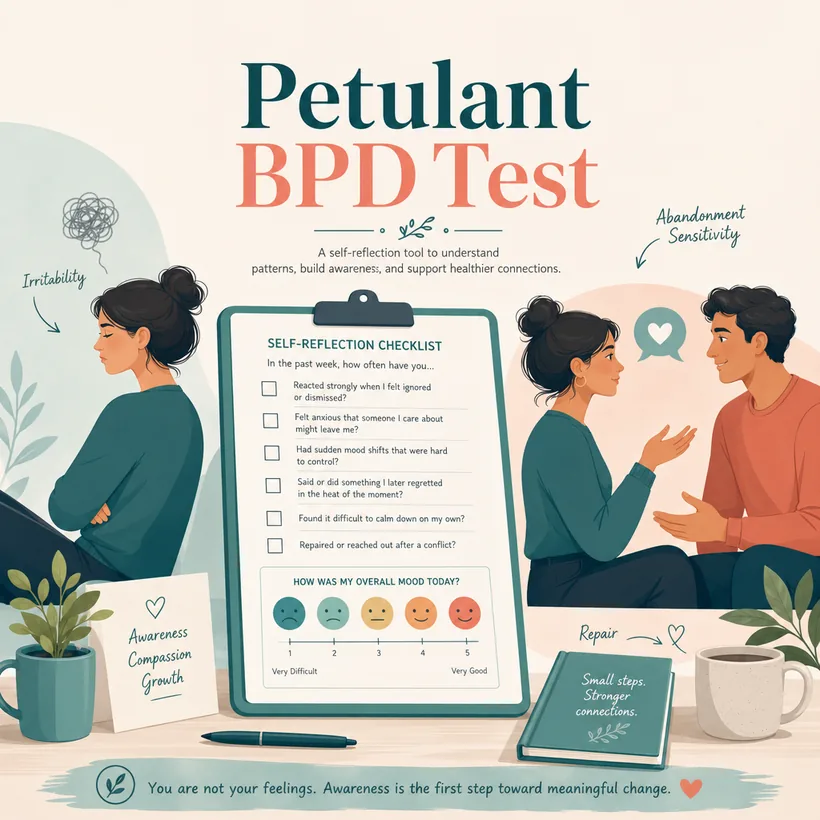
Petulant BPD Self-Reflection Questions
These questions are not a diagnostic petulant borderline personality disorder test. Use them as a structured mirror. If several questions feel familiar and the pattern causes distress or impairment, consider taking a broader comprehensive BPD test and discussing your results with a licensed clinician.
How to read your answers
If you answered yes to one or two questions, it may reflect normal relationship stress, attachment insecurity, burnout, trauma triggers, or a specific conflict. If many questions describe a long-term pattern, especially alongside impulsive behavior, self-harm urges, unstable identity, chronic emptiness, or intense mood shifts, a full BPD screening may be more useful than trying to identify one subtype.
Pay attention to frequency, intensity, duration, and consequences. A person can feel jealous or rejected without having BPD. The clinical concern increases when reactions are extreme, hard to regulate, repeatedly damage important relationships, or lead to unsafe behavior.
Want a broader screening picture?
Subtype questions can help you notice patterns, but a full assessment looks across the major BPD symptom areas.
Take the Comprehensive BPD TestPetulant BPD vs Quiet BPD
Petulant BPD and quiet BPD can both involve intense fear of abandonment, emotional sensitivity, shame, and difficulty feeling secure in relationships. The difference is often where the distress goes. In petulant patterns, distress may be expressed outwardly through irritation, protest, or conflict. In quiet BPD, distress is more often directed inward through self-blame, emotional suppression, withdrawal, or hidden self-punishment.
| Pattern | Petulant BPD | Quiet BPD |
|---|---|---|
| Common outward style | Irritable, protesting, resentful, demanding reassurance | Composed, self-critical, withdrawn, emotionally masked |
| Reaction to perceived rejection | May confront, accuse, test, or threaten to leave | May disappear, blame self, shut down, or silently spiral |
| Core emotional need | Proof that the relationship is secure | Safety from being too much, needy, or exposed |
| Best next step | Track anger, reassurance loops, and repair attempts | Track suppression, hidden distress, and self-punishment |
If your symptoms are mostly internalized, our Quiet BPD Test may be a better starting point. If you relate to both columns, that is common. Real people rarely fit cleanly into one subtype.
How Petulant BPD Fits With the 4 BPD Types
Many online resources discuss four informal BPD types: discouraged or quiet, impulsive, petulant, and self-destructive. These categories can help people describe patterns, but they are not separate official diagnoses. The official clinical task is to evaluate whether someone meets criteria for borderline personality disorder and whether other conditions, such as bipolar disorder, PTSD, depression, anxiety, ADHD, or substance use, may better explain the symptoms.
Petulant BPD tends to sit closest to anger, relational protest, and fear-driven control attempts. Impulsive BPD is more often discussed around risk-taking and thrill-seeking. Self-destructive BPD emphasizes self-sabotage or self-harm patterns. Discouraged or quiet BPD emphasizes internalized distress. A person may move between these patterns depending on stress level, relationship context, age, treatment progress, and current support.
For that reason, a "4 types of BPD test" can be interesting, but it should not be the endpoint. A better approach is to use type language for self-awareness, then use a broader BPD symptoms test to understand the full pattern. For the full subtype overview, see our BPD subtypes test guide.
When to Seek Professional Help
Consider professional support if your anger, fear of abandonment, or relationship testing feels uncontrollable, causes repeated breakups or workplace problems, or leads you to self-harm, suicidal thoughts, unsafe sex, reckless spending, substance use, or other risky behavior. NICE guidance for borderline personality disorder emphasizes structured psychological care, crisis planning, and careful assessment rather than quick labels.
A clinician may ask about your history, relationship patterns, trauma exposure, mood episodes, self-harm risk, substance use, sleep, and family background. They may also screen for conditions that can resemble or overlap with BPD. This process matters because the right treatment plan depends on the full picture, not just one subtype label.
What helps in the meantime?
- Pause before protest: Wait before sending the message that demands proof, threatens leaving, or lists every hurt.
- Name the primary emotion: Ask whether anger is protecting fear, shame, grief, or loneliness.
- Use specific requests: Replace "You never care" with "I am feeling insecure; can we agree on when we will talk?"
- Track repair: Notice whether you apologize, explain, and rebuild trust after emotional escalation.
- Use crisis support immediately: If you might hurt yourself or someone else, call emergency services or a local crisis line.
FAQ
Is petulant BPD an official diagnosis?
No. Petulant BPD is an informal subtype label. Clinicians diagnose borderline personality disorder through a comprehensive evaluation, not by assigning one online subtype.
Can a petulant BPD test tell me if I have BPD?
No online petulant BPD test can diagnose you. Self-reflection questions can show whether your patterns are worth discussing with a professional or exploring with a broader BPD screening tool.
What is the difference between petulant BPD and quiet BPD?
Petulant patterns usually express distress outwardly through anger, protest, resentment, or relationship testing. Quiet BPD patterns usually turn distress inward through masking, self-blame, withdrawal, or hidden self-punishment.
Can someone have both petulant and quiet BPD traits?
Yes. Subtype labels are descriptive, not rigid categories. Someone might appear quiet at work, petulant in romantic relationships, and impulsive during periods of intense stress.
What should I do if I relate to the petulant BPD signs?
Start by tracking repeated patterns and taking a broader BPD assessment. If the patterns cause distress, relationship damage, or safety concerns, speak with a licensed mental health professional.
Medical Disclaimer
This article is for educational purposes only and does not provide a diagnosis, treatment plan, or emergency support. If you are in immediate danger or may harm yourself or someone else, call emergency services or a local crisis hotline now.