Contents
A BPD symptoms test is a screening and self-assessment aid, not a diagnosis. It can help you review nine symptom areas, notice repeated patterns, and prepare focused questions for a qualified mental health professional. This guide explains what the checklist can show, what it cannot settle, and how to choose a safer next step.
💡 For broader BPD context, read our Complete Guide to Borderline Personality Disorder or Complete Guide to BPD Tests.
Important Medical Disclaimer
This self-assessment tool is for educational purposes only and is not intended to replace professional medical advice, diagnosis, or treatment. Only a qualified mental health professional can provide an accurate BPD diagnosis. If you're experiencing thoughts of self-harm or suicide, please seek immediate professional help or contact a crisis helpline.
Understanding BPD Symptoms
Borderline Personality Disorder is characterized by a pervasive pattern involving relationships, self-image, emotions, and behavior. The Diagnostic and Statistical Manual of Mental Disorders (DSM-5) describes nine BPD criteria; meeting five or more is one part of the diagnostic framework, but a count alone cannot establish a diagnosis.
Use a BPD symptoms test safely:
- Look for patterns over time, not one difficult day or one relationship conflict.
- Write down concrete examples, triggers, consequences, and what helped.
- Consider other explanations, including trauma, mood disorders, ADHD, anxiety, and substance use.
- Use the result to plan a conversation, never as proof that you have or do not have BPD.
BPD symptoms can affect relationships, identity, and daily functioning. For adolescents, see our BPD Test for Teens: Age-Appropriate Screening and Early Detection guide.
Screening is a starting point, not a diagnosis
A checklist can make a confusing experience easier to describe, but it does not measure developmental history, medical factors, current safety, or the full pattern across settings. If several items feel familiar, compare them with the examples in the sections below and bring the pattern to a professional rather than trying to self-diagnose from a score.
The 9 Core BPD Symptoms
The nine areas below are prompts for reflection across different situations and relationships.
Frantic Efforts to Avoid Abandonment
Intense fear of real or imagined abandonment, leading to desperate efforts to avoid being left alone. This may include:
- Constantly seeking reassurance from others
- Becoming clingy or possessive in relationships
- Panic when someone is late or doesn't respond immediately
- Making threats or engaging in manipulative behavior to prevent abandonment
Unstable Interpersonal Relationships
Pattern of intense, unstable relationships characterized by alternating between idealization and devaluation:
- Initially viewing new people as perfect or "all good"
- Sudden shifts to seeing them as "all bad" or terrible
- Difficulty maintaining long-term, stable relationships
- Relationships often end dramatically or abruptly
Identity Disturbance
Markedly and persistently unstable self-image or sense of self:
- Frequent changes in goals, values, or career aspirations
- Feeling like you don't know who you "really" are
- Adopting different personalities in different situations
- Feeling empty or like you have no core identity
Impulsivity in Harmful Areas
Impulsiveness in at least two areas that are potentially self-damaging:
- Spending money recklessly or compulsive shopping
- Substance abuse or excessive drinking
- Reckless driving or dangerous sexual behavior
- Binge eating or other harmful behaviors
Recurrent Suicidal Behavior
Recurrent suicidal behavior, gestures, threats, or self-mutilating behavior:
- Thoughts of suicide or death
- Self-harm behaviors like cutting or burning
- Suicide attempts or threats
- Using self-harm as a coping mechanism
Affective Instability
Marked reactivity of mood and intense episodic dysphoria, irritability, or anxiety:
- Rapid mood swings lasting hours to days
- Intense emotional reactions to minor events
- Difficulty returning to emotional baseline
- Emotions feel overwhelming and uncontrollable
Chronic Feelings of Emptiness
Persistent sense of inner emptiness or emotional void:
- Feeling hollow, numb, or "dead inside"
- Sense that something is missing but unsure what
- Difficulty feeling fulfilled or satisfied
- Constant search for something to fill the void
Inappropriate Intense Anger
Inappropriate, intense anger or difficulty controlling anger:
- Frequent displays of temper or anger
- Anger that seems disproportionate to the situation
- Difficulty calming down once angry
- Physical fights or verbal outbursts
Stress-Related Paranoid Ideation
Transient, stress-related paranoid ideation or severe dissociative symptoms:
- Feeling like others are "out to get you" during stress
- Temporary loss of reality or feeling "unreal"
- Feeling detached from yourself or your surroundings
- Paranoid thoughts that disappear when stress reduces
BPD Self-Assessment Questionnaire
This questionnaire is based on the DSM-5 diagnostic criteria for BPD. For each statement, rate how well it describes your typical thoughts, feelings, and behaviors over the past year using the scale below.
Rating Scale:
BPD Symptoms Assessment
I go to extreme lengths to avoid real or imagined abandonment by friends, family, or romantic partners. I panic when someone is late or doesn't respond to my messages immediately.
My relationships are intense but unstable. I tend to idealize people initially, seeing them as perfect, but then become disappointed and see them as terrible or worthless.
I have an unstable sense of self. My goals, values, opinions, or career plans change frequently. I often feel like I don't know who I really am.
I engage in impulsive behaviors that could be harmful, such as reckless spending, unsafe sex, substance abuse, reckless driving, or binge eating.
I have recurring thoughts of suicide, have made suicide attempts, or engage in self-harming behaviors like cutting, burning, or hitting myself.
I experience intense, rapid mood swings. My emotions feel overwhelming and change quickly in response to stress or interpersonal conflicts.
I frequently feel empty, hollow, or like there's a void inside me. Life often feels meaningless or like something important is missing.
I have intense anger that seems inappropriate for the situation. I have trouble controlling my temper and may have physical fights or verbal outbursts.
During times of stress, I become suspicious of others' motives or feel disconnected from myself or reality, like I'm watching myself from outside my body.
Add up all your ratings to get your total score
How to Interpret Your Results
Your BPD symptoms test results can organize observations, but there is no validated self-scoring cutoff on this page. A lower total does not rule out distress, and a higher total does not prove BPD; repeated patterns, impairment, and safety matter more than a number.
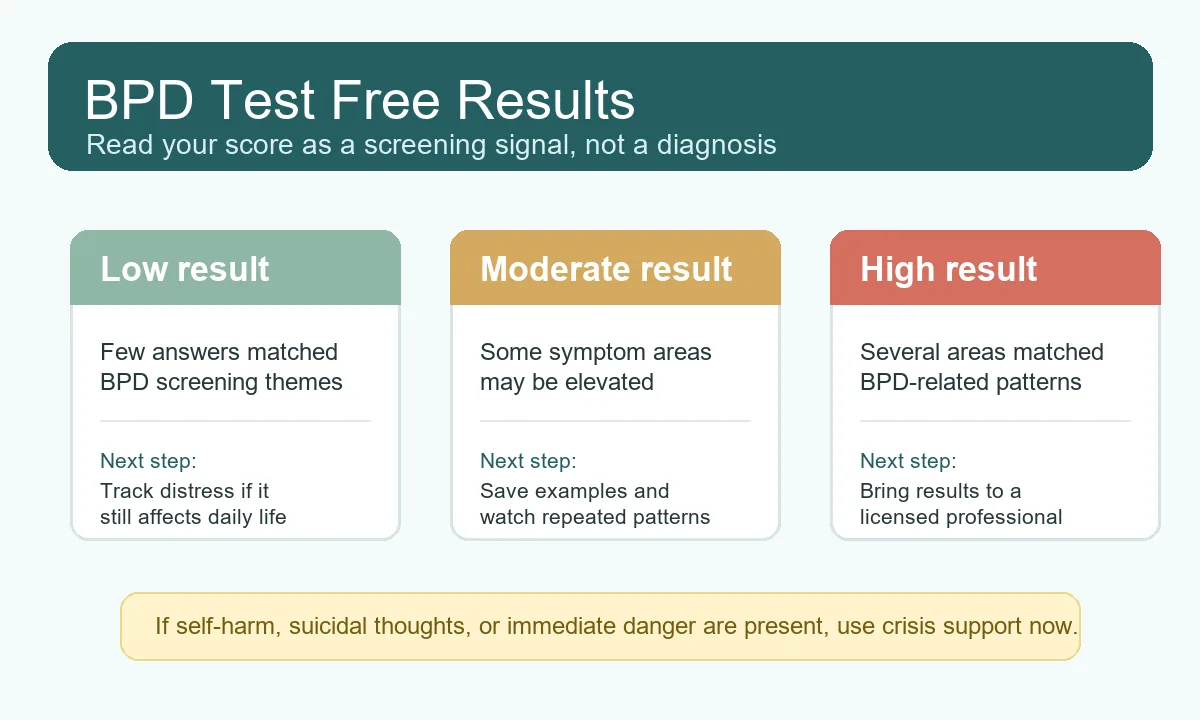
Key Points About Your Results:
- Self-assessment limitations: This questionnaire cannot replace a professional clinical assessment
- Diagnostic criteria: A BPD diagnosis requires meeting 5 or more of the 9 DSM-5 criteria
- Severity matters: Higher scores (ratings of 2-3) on individual items are more clinically significant
- Context is important: Consider how long you've experienced these symptoms and their impact on your life
What High Scores May Indicate
If you scored high on this assessment, it may suggest that you're experiencing symptoms consistent with BPD. However, many mental health conditions share similar symptoms, including:
| Condition | Similar Symptoms | Key Differences |
|---|---|---|
| Major Depression | Emptiness, mood instability | Depression is episodic; BPD is pervasive |
| Bipolar Disorder | Mood swings, impulsivity | Bipolar has distinct manic/depressive episodes |
| PTSD | Emotional dysregulation, dissociation | PTSD symptoms relate to specific trauma |
| ADHD | Impulsivity, emotional reactivity | ADHD focuses on attention/hyperactivity |
Next Steps and Professional Help
Use your score as a prompt for the next step:
Low-Moderate Scores (0-12)
- Consider general mental health resources
- Practice self-care and stress management
- Monitor symptoms over time
- Consult a counselor if symptoms worsen
Recommended reading: High-Functioning BPD Guide
High Scores (13-27)
- Schedule evaluation with a mental health professional
- Consider specialized BPD therapy (DBT, MBT)
- Join support groups or online communities
- Develop crisis safety plan if needed
Crisis resources: 988 Suicide & Crisis Lifeline available 24/7
Finding Professional Help
Look for mental health providers trained in personality disorders. Our BPD assessment guide explains what to expect, and the NIMH BPD overview explains why care should be individualized.
Evidence-Based Treatments for BPD
Professionals may discuss therapies such as Dialectical Behavior Therapy, Mentalization-Based Therapy, or Schema Therapy. The right plan depends on the person’s goals, risks, co-occurring conditions, access, and preferences; a screening result should not determine treatment by itself.
Ready to Take the Next Step?
If your results suggest you may benefit from professional evaluation, don't wait. Early intervention leads to better outcomes.
Take Our Comprehensive BPD TestBPD Symptoms Test FAQ
Can a BPD symptoms test diagnose BPD?
No. A screening score can organize symptom patterns, but diagnosis requires a qualified professional to review history, context, impairment, safety, and other possible explanations.
What should I do after a high score?
Write down the examples behind your answers and discuss them with a mental health professional. Do not change medication or treat the score as proof of a diagnosis.
What does a BPD symptoms test measure?
It usually asks about BPD-related symptom areas such as abandonment fears, unstable relationships, identity changes, impulsivity, self-harm, emotional reactivity, emptiness, anger, or dissociation. The wording and scoring vary, so use the result as a discussion prompt rather than a definitive measurement.
How many symptoms are needed for a BPD diagnosis?
The DSM-5 framework describes five or more of nine criteria as part of the diagnostic threshold, but clinicians also review duration, context, impairment, safety, developmental history, and other possible explanations. Counting checklist items by itself is not enough.
Important Reminders
This self-assessment is not a diagnostic tool. Only qualified mental health professionals can provide accurate diagnoses. If you're experiencing thoughts of self-harm or suicide, seek immediate professional help or contact emergency services.
Crisis Resources:
- National Suicide Prevention Lifeline: 988
- Crisis Text Line: Text "HELLO" to 741741
- National Alliance on Mental Illness (NAMI): 1-800-950-NAMI (6264)