Table of Contents
Quick Answer: Is It BPD or Bipolar Disorder?
A quiz-style self-check can help you notice whether your mood changes look more like BPD-related emotional reactivity, bipolar mood episodes, both, or something else. It cannot diagnose you. The most useful clues are duration, triggers, relationship patterns, energy changes, sleep changes, impulsivity, safety risk, and whether mood shifts happen in distinct episodes.
If you searched for "do I have BPD or bipolar quiz," you are probably trying to understand intense mood swings without jumping to the wrong label. That is a reasonable question. BPD and bipolar disorder can both involve intense emotions and impulsive behavior, but they are different conditions with different treatment priorities. BPD is usually described around patterns in relationships, self-image, emotional regulation, and abandonment fear. Bipolar disorder is usually described around episodes of depression, hypomania, or mania.
Important safety note
If your mood changes include suicidal thoughts, self-harm urges, not sleeping for days, reckless behavior that could seriously harm you, psychosis, or feeling unable to stay safe, seek urgent professional help now. Online comparison tools are not enough in a crisis.
Quiz-Style Self-Check: Which Pattern Fits Better?
Use the questions below as a reflection tool. Do not add up points and diagnose yourself. Instead, look for repeated patterns across months or years, not just one difficult week.
- Do your mood shifts often happen within minutes or hours after conflict, rejection, silence, shame, or fear of abandonment?
- Do your high-energy periods last for several days with much less sleep, unusually elevated or irritable mood, faster speech, racing thoughts, and increased activity?
- Do relationship events quickly change how you feel about yourself or another person?
- Do you have distinct depressive or hypomanic/manic episodes that others can notice even when relationships are stable?
- Do you often feel empty, terrified of being left, or unsure who you are?
- During elevated periods, do you feel unusually powerful, invincible, grand, or unable to slow down?
- Are impulsive choices usually attempts to escape emotional pain after a trigger?
- Are impulsive choices clustered inside clear mood episodes with decreased need for sleep or unusually high energy?
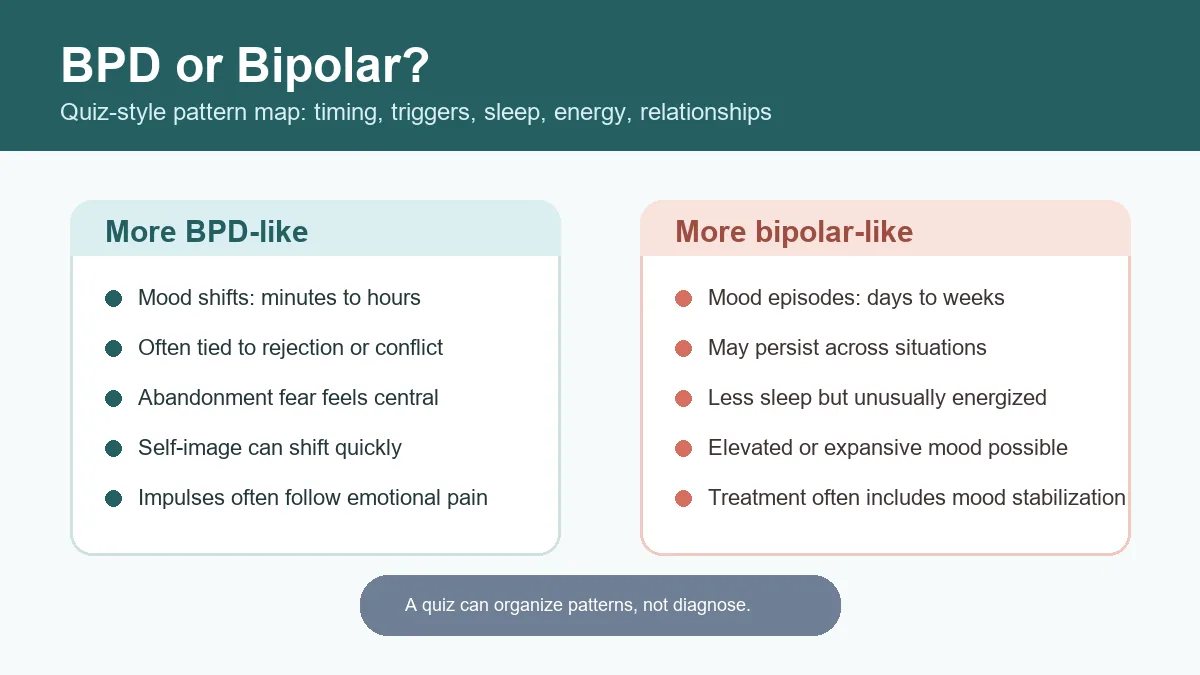
BPD vs Bipolar: The Main Differences to Compare
The clearest difference is often the shape of the mood change. A Cleveland Clinic clinical overview describes BPD mood shifts as more frequent and relationship-linked, while bipolar disorder involves longer-lasting mood episodes. The National Institute of Mental Health also describes BPD as involving ongoing instability in moods, behavior, self-image, and functioning, while its bipolar disorder overview centers on episodes of mood, energy, activity, and concentration changes.
| Question to ask | More consistent with BPD traits | More consistent with bipolar disorder |
|---|---|---|
| How long do mood changes last? | Often minutes to hours, sometimes a day, especially after interpersonal stress. | Hypomania usually lasts days; mania and depression often last longer and form clearer episodes. |
| What triggers the shift? | Rejection, conflict, abandonment fear, shame, criticism, or perceived distance. | Episodes may happen without a clear relationship trigger and can persist across settings. |
| What happens to sleep? | Sleep may be disrupted by distress, anxiety, rumination, or crisis. | Decreased need for sleep with high energy can be a warning sign of hypomania or mania. |
| What happens in relationships? | Fear of abandonment, intense closeness, sudden anger, withdrawal, testing, or idealization and devaluation. | Relationships may suffer during episodes, but abandonment fear is not usually the central feature. |
| What treatment is usually emphasized? | Structured psychotherapy such as DBT, safety planning, emotion regulation, and relationship skills. | Professional diagnosis often leads to medication-focused mood stabilization plus therapy and lifestyle planning. |
Mood swings are not all the same
People often use "mood swings" to describe any intense emotional change. Clinically, the details matter. BPD-like mood shifts are often reactive: something happens, the feeling surges, the relationship feels unsafe, and the person may seek reassurance, withdraw, argue, self-blame, or act impulsively. Bipolar mood episodes are usually broader changes in mood, energy, sleep, activity, and thinking that last long enough to disrupt functioning across contexts.
Energy and sleep are especially important
When someone says, "I feel amazing and only need two hours of sleep," that detail matters. Decreased need for sleep is different from insomnia. In insomnia, you are tired but cannot sleep. In hypomania or mania, a person may sleep very little and still feel energized, driven, wired, or unusually confident. That pattern deserves professional attention.
What Your Answers May Suggest
If most of your answers fit BPD-like patterns, consider using a BPD screening tool as a starting point. Our Quick BPD Screening can help you orient yourself, while the Comprehensive BPD Test gives a broader look across symptom areas. If your symptoms are mostly hidden, masked, or turned inward, the Quiet BPD Test may be more relevant.
If most of your answers fit bipolar-like patterns, especially decreased need for sleep, elevated energy, risky behavior, or depression that lasts for weeks, a BPD test is not enough. Consider asking a licensed clinician about bipolar screening and a full mood history. Bring a timeline of sleep, energy, mood, spending, sex, substance use, irritability, speech changes, and functional problems.
If your answers are mixed, do not force a single label. It may be BPD plus bipolar disorder, BPD plus trauma symptoms, bipolar disorder plus relationship stress, ADHD-related emotional impulsivity, substance effects, depression, anxiety, or another pattern. A good assessment looks at the full timeline instead of one quiz result.
Can You Have Both BPD and Bipolar Disorder?
Yes, a person can have both, and overlap can make self-assessment confusing. The mistake is assuming that one label automatically rules out the other. A clinician may ask about family history, episode duration, antidepressant reactions, trauma history, relationship patterns, self-harm risk, substance use, and whether symptoms remain between mood episodes.
That is why a single "BPD or bipolar quiz" should never be treated as a diagnosis. The most helpful role of a quiz is to organize your observations so a professional can ask better follow-up questions. If you already have one diagnosis but something still does not fit, bring that concern to the clinician instead of changing medication or treatment on your own.
What to Do Next
Start by writing a one-page timeline. Include the approximate age symptoms began, the longest elevated-energy period, the longest depressive period, typical triggers, sleep changes, relationship patterns, self-harm or suicidal thoughts, substance use, and any past diagnoses or medications. This is more useful than a screenshot of a quiz score alone.
Then choose the next step based on risk and pattern:
- If there is immediate danger, use emergency or crisis support now.
- If BPD-like patterns are most prominent, take a BPD screening and read the BPD symptoms test guide.
- If bipolar-like episodes are prominent, ask for a professional mood disorder assessment.
- If you are comparing several conditions, read the broader BPD vs other mental health conditions guide.
- If you are under 18 or asking about a teen, use extra caution and start with the teen BPD diagnosis age guide.
Want to screen BPD traits first?
Use the comprehensive BPD assessment as a self-reflection tool, then bring concerning patterns to a qualified professional.
Take the Comprehensive BPD TestFAQ
Is there a reliable quiz for BPD or bipolar disorder?
A quiz can be useful for screening and self-reflection, but it cannot reliably diagnose either condition. BPD and bipolar disorder require a professional assessment of symptom history, duration, impairment, safety, and possible overlapping conditions.
What is the biggest difference between BPD and bipolar mood swings?
BPD-like shifts are often faster and tied to interpersonal triggers, while bipolar mood episodes usually last longer and include broader changes in energy, sleep, activity, and functioning.
Can BPD look like bipolar disorder?
Yes. Intense emotions, impulsivity, anger, depression, and self-harm risk can make the two look similar. Timing, triggers, sleep, elevated energy, and relationship patterns help clinicians separate them.
Can bipolar disorder look like BPD?
Yes. During mood episodes, bipolar disorder can involve impulsive choices, irritability, relationship conflict, and emotional intensity. A clinician looks for distinct manic, hypomanic, or depressive episodes.
Should I take a BPD test if I think I might be bipolar?
You can use a BPD test for self-reflection, but if you have signs of hypomania or mania, especially decreased need for sleep and unusually elevated energy, you should seek a professional mood disorder assessment as well.
Medical Disclaimer
This article is for educational purposes only and cannot diagnose, treat, or replace professional mental health care. If you are in immediate danger or may harm yourself or someone else, call emergency services or a local crisis hotline now.