BPD in relationships can involve intense closeness, rejection sensitivity, rapid emotional shifts, and difficulty staying connected during conflict. These patterns do not prove a relationship is doomed. The useful question is whether both people can recognize the cycle, protect safety, respect boundaries, and practice repair.
Borderline personality disorder affects people differently. Some people seek reassurance; others withdraw or end contact first. A partner may pursue, defend, shut down, or over-accommodate, intensifying the original alarm. Looking at the sequence is more useful than assigning a villain.
Safety is not a communication exercise
If conflict includes threats of suicide, self-harm, violence, stalking, coercive control, forced sex, blocked exits, weapon access, or fear that anyone may be harmed, prioritize crisis and safety support. In the United States, call or text 988 for crisis support and call 911 for immediate danger. Elsewhere, contact local crisis or emergency services. A diagnosis never requires someone to remain in an unsafe relationship.
Table of Contents
How Can BPD Affect Relationships?
The National Institute of Mental Health describes BPD as involving difficulty regulating emotions and, for some people, a pattern of intense or unstable relationships, sensitivity to rejection, and efforts to avoid real or perceived abandonment. Not everyone experiences every symptom, and severity can change over time.
In a close relationship, ordinary uncertainty may carry unusually high emotional weight. A delayed message can feel like rejection. A request for space can feel like permanent abandonment. A disagreement can briefly erase the felt memory of affection. These reactions may be followed by repeated contact, accusations, testing, people pleasing, abrupt withdrawal, or a rapid switch between idealizing and devaluing the other person.
Those behaviors still have consequences, even when they begin as attempts to reduce fear. Understanding the emotional function of a behavior is not the same as excusing harm. Healthy change requires both compassion and accountability: “I understand why my alarm activated” and “I am responsible for what I do next” can both be true.
A Common BPD Relationship Cycle
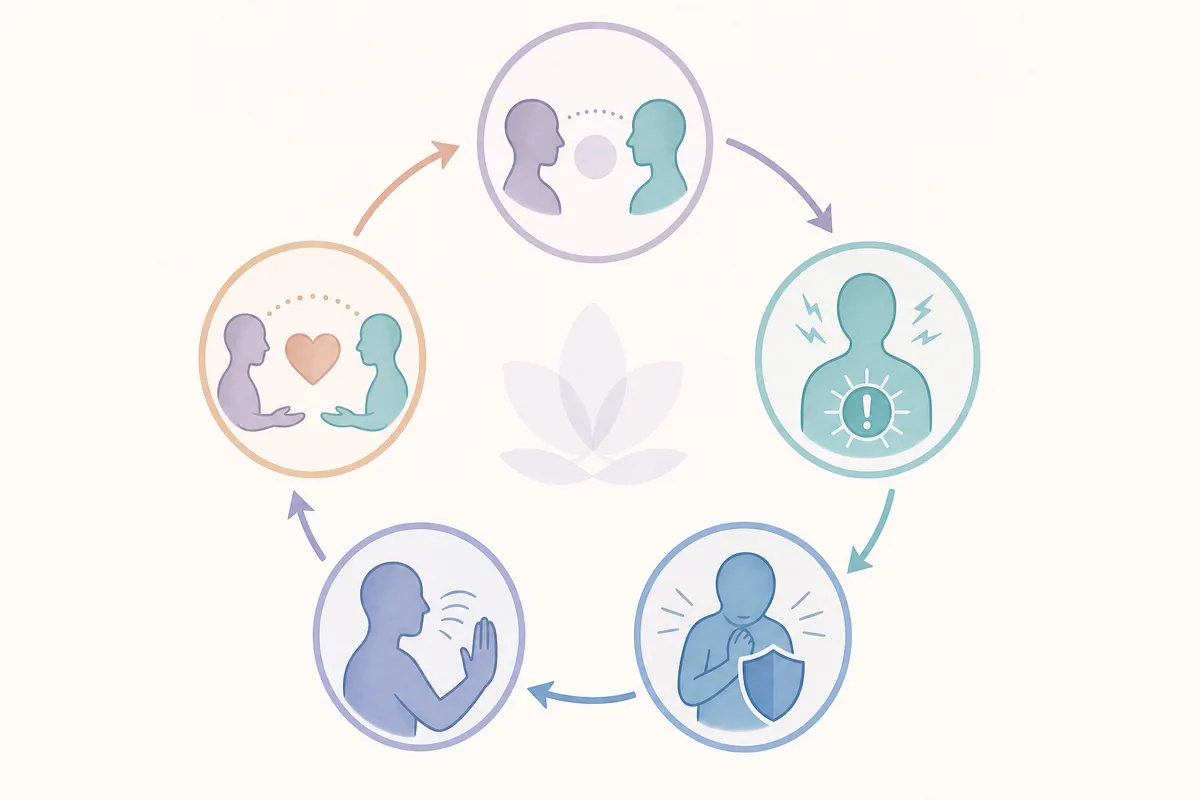
A cycle is not a fixed personality description. It is a sequence that can be observed and interrupted. The details vary, but many difficult interactions include five stages:
- Trigger: distance, an ambiguous tone, a changed plan, criticism, jealousy, or a boundary.
- Alarm: sudden fear, shame, anger, emptiness, unreality, or certainty that the relationship is ending.
- Protective urge: seek immediate reassurance, attack, test loyalty, withdraw, block, numb, or end the relationship first.
- Reaction: both people respond to the alarm, often while dysregulated, creating more evidence that the relationship is unsafe.
- Repair or repetition: the pair slows down, owns behavior, and makes a plan—or returns to the same cycle without learning from it.
For a cycle centered on being left, read the BPD fear of abandonment guide. If the shift is mainly between “all good” and “all bad,” the BPD splitting self-reflection guide explains that narrower pattern. When one person becomes the main source of emotional stability, the favorite person guide may be more specific.
Relationship Patterns Are Not a Diagnosis
Relationship distress alone cannot establish BPD. Trauma responses, anxious or avoidant attachment, depression, bipolar disorder, ADHD-related rejection sensitivity, autism, substance use, grief, current abuse, and ordinary incompatibility can produce overlapping experiences. A licensed clinician considers the long-term pattern, symptoms across settings, impairment, safety, personal history, and other explanations.
| What you notice | Questions that clarify the pattern | Useful next step |
|---|---|---|
| Rapid fear after distance or a boundary | What happened, what did I assume, and what remains unknown? | Pause urgent action, check facts, and make one clear request. |
| Fast shift from closeness to anger or disgust | Can I hold mixed evidence about this person while upset? | Delay major decisions and review the splitting pattern after regulation. |
| One person manages nearly all emotional stability | Have friends, routines, sleep, therapy, and independent interests disappeared? | Rebuild multiple sources of support rather than demanding less closeness. |
| Repeated fear, control, or boundary violations | Is either person afraid, isolated, coerced, monitored, or unsafe? | Use individual safety support; do not use couples exercises to manage abuse. |
Communication During Emotional Intensity
Good communication is hardest when the nervous system is treating uncertainty as an emergency. The first goal is not to win the interpretation; it is to lower the risk of an impulsive action and make the next conversation possible.
For the person experiencing the alarm
- Describe the observable event before the story: “The plan changed” rather than “You never want me.”
- Name the emotion and urge: “I feel panicked and want to send ten messages.”
- Ask for one specific, time-limited action: “Can we check in at 7 p.m.?”
- Delay threats, breakups, public posts, substance use, unsafe driving, or uninvited visits during peak emotion.
- Return after regulation to own impact without turning the apology into a demand for immediate reassurance.
For a partner or loved one
- Validate emotion without confirming an inaccurate conclusion: “I can see this feels frightening” is different from “Yes, I abandoned you.”
- Use clear timing instead of vague disappearance: “I need 30 minutes, and I will return at 6:30.”
- Keep a stated boundary steady. Repeatedly changing it under pressure may unintentionally reinforce escalation.
- Avoid diagnosing every disagreement, using “your BPD” as a weapon, or debating details during a safety crisis.
- Maintain your own support, sleep, friendships, privacy, and access to individual counseling.
Boundaries That Protect Both People
A boundary describes what you will do to protect safety, time, privacy, or wellbeing. It is not a threat designed to control the other person. “If shouting starts, I will pause the conversation and return at the agreed time” is clearer than “You are not allowed to be angry.”
Useful relationship agreements may cover how to request a pause, when the conversation will resume, what counts as an emergency, whether location or phone access is private, how many follow-up messages are reasonable, what happens after insults or threats, and which support person each individual will contact. Agreements should be specific, mutual, realistic, and reviewed when both people are calm.
When problem-solving should stop
Do not keep analyzing the relationship during threats, coercion, stalking, violence, forced sex, blocked exits, or fear of imminent harm. Move to individual safety support and emergency or crisis services. Relationship skills cannot make abuse safe, and a BPD label never explains away another person’s right to leave.

What repair sounds like
Name behavior: “I sent repeated messages and called you uncaring.”
Own impact: “That put pressure on you and made the conversation less safe.”
Explain without excusing: “I was afraid the relationship was ending, but the fear does not justify the insult.”
Offer a specific change: “Next time I will send one message, use my coping plan, and wait until our check-in time.”
Allow choice: “You do not have to resolve this immediately. Tell me what you need before we continue.”
Treatment and Support for BPD Relationships
Psychotherapy is the primary treatment for BPD. The NIMH notes that approaches such as dialectical behavior therapy can help people regulate intense emotions, reduce self-destructive behavior, and improve relationships. Treatment is not only about preserving a particular relationship; it should also strengthen safety, functioning, identity, and the ability to make choices.
Individual therapy can help identify triggers, practice distress tolerance, improve communication, and review the consequences of behavior. Partners and family members may benefit from their own counseling or skills education. Couples or family work may be useful when a qualified clinician considers it appropriate and there is no coercive control or ongoing violence.
If you are wondering whether relationship distress is part of a broader BPD pattern, use the safe “Do I Have BPD?” self-check guide or read how professional BPD assessment works. Screening can organize questions, but it cannot diagnose either partner from a relationship story.
Need a broader symptom picture?
Use online screening as a private starting point, then bring repeated relationship, functioning, or safety concerns to a licensed mental health professional.
View the Comprehensive BPD ScreeningFAQ About BPD in Relationships
Can someone with BPD have a healthy relationship?
Yes. A diagnosis does not determine the quality or future of every relationship. Stability is more likely when people take responsibility for behavior, use treatment and coping skills, communicate clearly, respect boundaries, and address safety concerns directly.
What is the BPD relationship cycle?
The phrase usually describes a repeating sequence of trigger, emotional alarm, protective urge, reaction, and either repair or renewed conflict. It is an educational description, not a formal diagnostic stage model, and it should not be used to stereotype every person with BPD.
How long do BPD relationships last?
There is no reliable timeline based on diagnosis alone. Relationship duration depends on many factors, including compatibility, treatment, accountability, communication, safety, outside stress, and whether both people want and are able to continue.
Why might a partner with BPD push me away?
Withdrawal can follow shame, fear of rejection, anger, emotional overload, dissociation, or a wish to avoid being left first. It can also reflect an ordinary need for distance or a decision to end the relationship. Ask clearly, respect stated boundaries, and avoid diagnosing motives from silence alone.
Should I stay in a relationship because my partner has BPD?
No diagnosis obligates someone to stay. Consider safety, consent, respect, accountability, compatibility, and whether change is occurring—not only promises made after conflict. Individual professional support can help you make a decision without turning a diagnosis into either a reason to leave automatically or a reason to tolerate harm.
Sources and Further Reading
Medical Disclaimer
This page provides general education, not diagnosis or individualized treatment. Contact emergency or local crisis services if you may harm yourself or someone else, cannot stay safe, or face immediate danger.