A discouraged BPD test is not a clinical diagnosis. It is a structured way to notice whether your borderline personality disorder traits may be hidden, inward, self-blaming, or easy for other people to miss.
If you searched for "discouraged BPD test," you may already suspect that your distress does not look loud or dramatic from the outside. You might keep working, caregiving, studying, apologizing, and appearing composed while privately feeling rejected, ashamed, empty, dependent, angry at yourself, or afraid that asking for reassurance will make people leave. This guide helps you separate that inward pattern from a diagnosis, then decide whether a broader Quiet BPD Test or professional assessment is the better next step.
In this guide
Short answer: discouraged BPD is usually discussed as an informal subtype or pattern within BPD, often overlapping with quiet BPD. It points to inward distress, dependency fears, shame, withdrawal, self-criticism, and hidden emotional intensity. It does not replace a full evaluation by a licensed mental health professional.
What Does Discouraged BPD Mean?
Discouraged BPD is a subtype label used in some personality theory and online education. It is not a separate diagnosis in the DSM. The useful part of the label is descriptive: it can help someone name a pattern where BPD-related distress is more likely to turn inward than outward.
The National Institute of Mental Health describes borderline personality disorder as involving difficulty with emotions, self-image, behavior, and relationships. A discouraged pattern may still involve those same core areas, but the person may present as compliant, self-effacing, dependent, careful, or high-functioning. The inner experience can be much more intense than the public presentation.
Researchers and clinicians do not all agree that BPD subtypes are stable categories. A published case report on discouraged-type BPD discusses the label as part of a subtype model, not as a standalone diagnosis. That distinction matters. The question is not "Which subtype am I forever?" The better question is "What repeated patterns are causing distress, impairment, relationship strain, or safety risk?"
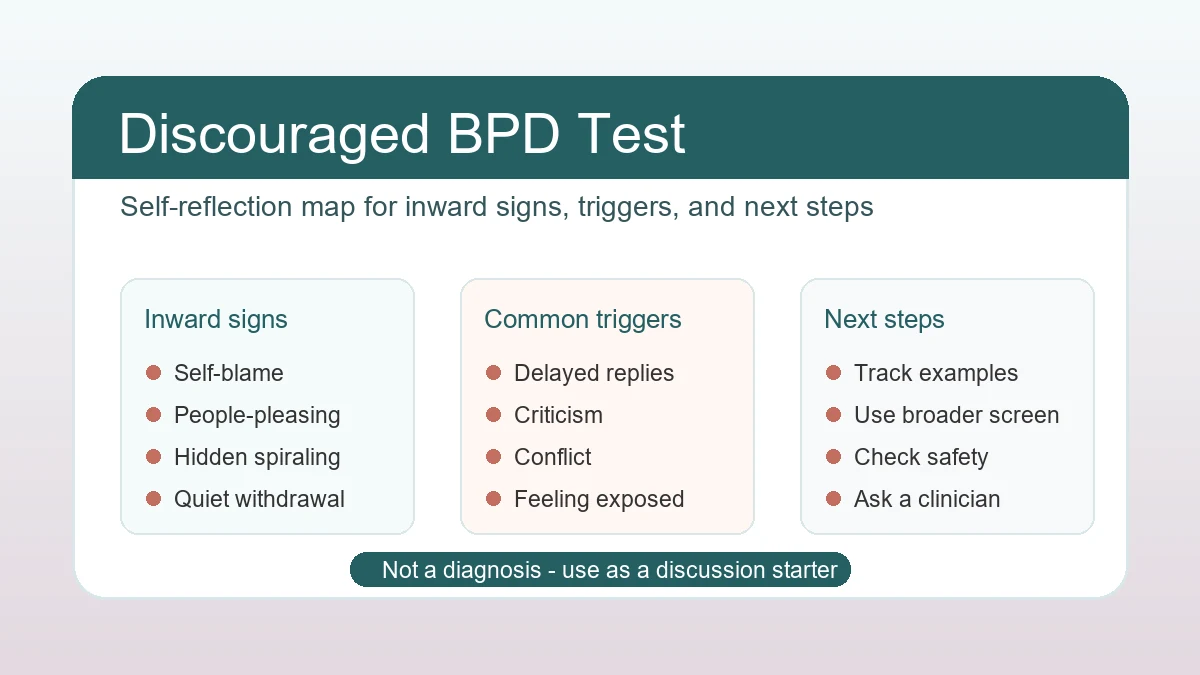
Discouraged BPD Test: 12 Self-Reflection Questions
Use these questions as a mirror, not as a score sheet. Answer based on repeated patterns over time, especially patterns that show up in close relationships, conflict, rejection, shame, or stress. One or two familiar answers may reflect ordinary stress. A consistent cluster that causes distress or impairment deserves more careful assessment.
How to read your answers
If only a few questions fit during a temporary stressful period, start by tracking sleep, conflict, workload, grief, trauma triggers, substance use, and support. If many questions describe a long-term pattern, especially alongside fear of abandonment, unstable relationships, self-harm urges, dissociation, impulsive coping, or intense mood shifts, a broader BPD screening may be more useful than a subtype quiz.
It can help to write one real example for each "yes." For example, instead of writing "I fear abandonment," write "When my partner did not reply for four hours, I felt sure they were done with me, apologized repeatedly, then stayed awake replaying everything I said." Specific examples make the pattern easier to discuss with a therapist.
Discouraged BPD vs Quiet, Petulant, and Impulsive Patterns
Discouraged BPD and quiet BPD overlap heavily. Many people use the terms almost interchangeably. The difference is that "discouraged" often emphasizes dependency, helplessness, shame, and withdrawal, while "quiet BPD" is a broader everyday search term for internalized BPD symptoms. Neither term is an official diagnosis. For a symptom-focused explanation, see our quiet BPD symptoms guide.
| Pattern | Common inner experience | Common outward appearance | Helpful next step |
|---|---|---|---|
| Discouraged BPD | Shame, dependency fear, helplessness, rejection sensitivity | Compliant, self-critical, withdrawn, careful not to burden others | Track self-blame, avoidance, reassurance needs, and withdrawal cycles |
| Quiet BPD | Intense emotions turned inward, hidden anger, private spiraling | High-functioning, composed, people-pleasing, emotionally masked | Use the Quiet BPD Test if symptoms are mostly internalized |
| Petulant BPD | Fear, anger, resentment, urgent need for proof of care | Protest, relationship testing, irritation, conflict after perceived rejection | Compare with the Petulant BPD Test guide |
| Impulsive BPD | Urgency, emotional escape, thrill-seeking, regret after relief fades | Risky spending, substance use, unsafe sex, reckless driving, sudden decisions | Track triggers, short-term relief, and long-term cost before choosing a label |
What to Do With Your Discouraged BPD Test Answers
The most useful next step is to move from labels to patterns. A discouraged label can explain why you have been missed, dismissed, or seen as "too functional" to need help. It should not keep you stuck in self-diagnosis. Use your answers to decide what kind of support fits the actual pattern.
- Start with a broader screen: If the pattern is mostly inward, take the Quiet BPD Test. If symptoms include many different areas, use the Comprehensive BPD Test.
- Bring examples, not just scores: Write down recent situations involving rejection fear, emotional masking, self-blame, impulsive coping, emptiness, or withdrawal.
- Check safety first: If you have suicidal thoughts, self-harm urges, threats of harm, or cannot stay safe, use emergency or crisis support now. Do not wait for an online article or quiz.
- Ask about differential diagnosis: Depression, anxiety, trauma responses, ADHD, bipolar disorder, substance use, and other conditions can overlap with BPD-like patterns.
- Look for structured care: NICE guidance emphasizes careful assessment, psychological treatment, and crisis planning rather than quick labels.
Want a broader screen for inward BPD traits?
Use the quiet BPD assessment if your symptoms are mostly hidden, masked, or turned inward.
Take the Quiet BPD TestFAQ
Is discouraged BPD the same as quiet BPD?
They overlap, but they are not formal diagnostic labels. Discouraged BPD often emphasizes shame, dependency fears, withdrawal, and self-blame. Quiet BPD is a broader term for internalized BPD patterns.
Can a discouraged BPD test diagnose me?
No. Online self-reflection questions can help you organize examples, but only a qualified clinician can diagnose borderline personality disorder after a full assessment.
What are common discouraged BPD signs?
Common signs may include intense rejection sensitivity, people-pleasing, emotional masking, self-blame, quiet resentment, withdrawal, hidden self-punishment, and fear of being too needy or too much.
Why does discouraged BPD get missed?
It can be missed because the person may appear calm, productive, agreeable, or high-functioning. The most painful symptoms may happen privately or be explained as depression, anxiety, perfectionism, or relationship stress.
What should I do if many questions fit?
Track real examples, take a broader BPD screening if appropriate, and consider speaking with a licensed mental health professional. Seek immediate crisis support if there is any risk of harm.
Medical Disclaimer
This article is for educational purposes only and does not provide a diagnosis, treatment plan, or emergency support. If you are in immediate danger or may harm yourself or someone else, call emergency services or a local crisis hotline now.