Table of Contents
Quick Answer: What Do BPD Test Free Results Tell You?
BPD test free results can show whether your answers match common borderline personality disorder symptom patterns, but they cannot diagnose you. A useful result explains your score, highlights which symptom areas were elevated, and gives clear next steps for self-reflection or professional assessment.
If you have not taken a screening yet, start with the Quick BPD Screening or the Comprehensive BPD Test. If you are still asking whether a BPD test fits your situation at all, first read the safe BPD self-check guide. If you already have a result, use this guide to understand what low, moderate, or high scores can mean, how to avoid self-diagnosis, and when to bring the result to a licensed mental health professional.
Important safety note
If your result came after a crisis, self-harm urge, suicidal thought, threat of violence, or feeling unable to stay safe, do not wait for more online information. Use emergency services or a crisis hotline now. Online screening is only a starting point.
What Free BPD Test Results Can and Cannot Mean
A free BPD test with results is usually a screening tool. It asks about experiences such as fear of abandonment, unstable relationships, identity confusion, impulsive behavior, self-harm risk, intense mood shifts, chronic emptiness, anger, or stress-related dissociation. Those areas resemble the symptom themes described by the National Institute of Mental Health, but a questionnaire is not the same thing as a clinical interview.
A good screening result helps you notice patterns. It should not tell you that you "definitely have BPD." Diagnosis requires a trained clinician who can look at symptom duration, impairment, safety, trauma history, mood episodes, substance use, medical causes, and other conditions that may look similar.
This matters because several conditions can overlap with BPD traits. Anxiety, depression, PTSD, bipolar disorder, ADHD, eating disorders, substance use, and relationship trauma can all affect mood, impulse control, identity, and relationships. A result is most useful when you treat it as evidence to discuss, not as a final label.
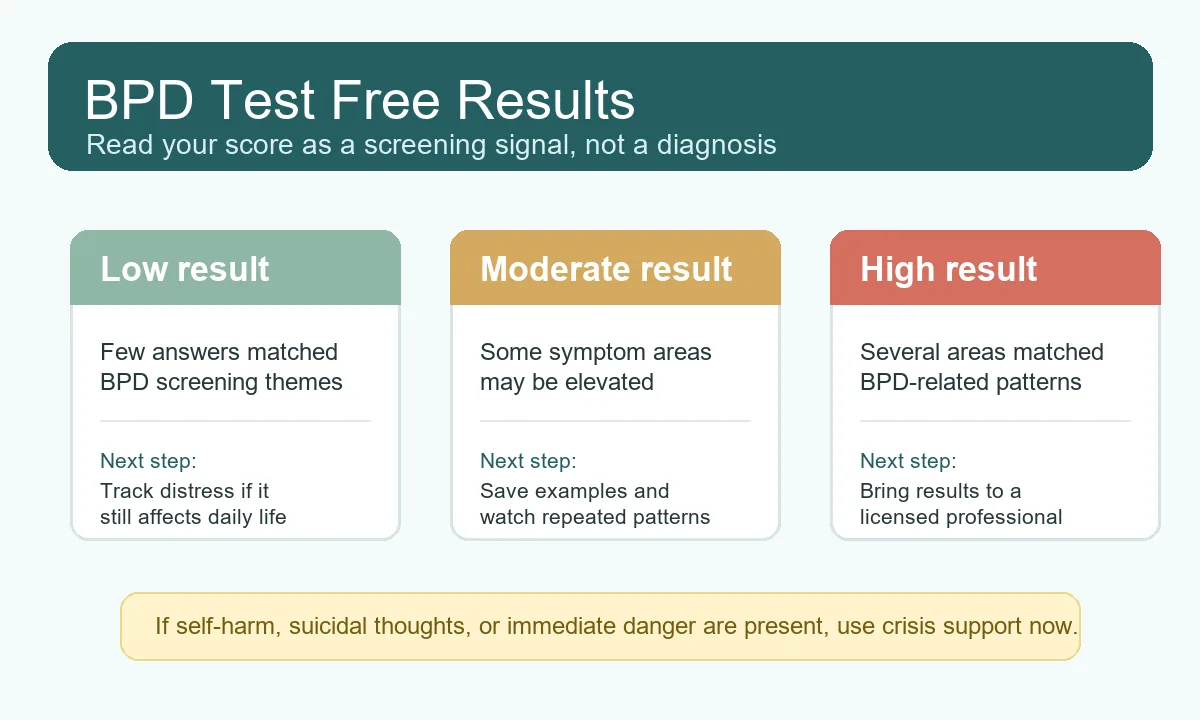
How to Read Low, Moderate, and High Score Ranges
Every BPD screening tool uses its own scoring rules, so do not compare numbers across different websites as if they mean the same thing. Instead, read the explanation attached to the test you took and focus on the pattern: which symptom areas were strongest, how often they happen, and whether they cause real problems in your life.
| Result pattern | What it may suggest | Reasonable next step |
|---|---|---|
| Low score | Your answers did not strongly match common BPD screening patterns. | If you still feel distressed, compare other explanations such as anxiety, depression, trauma, ADHD, or relationship stress. |
| Moderate score | Some BPD-related traits may be present, but the result needs context. | Track examples over several weeks and consider a broader assessment if symptoms are repeated or impairing. |
| High score | Your answers strongly matched several BPD screening themes. | Save your result, note the most accurate questions, and consider discussing it with a licensed clinician. |
| High score plus safety concerns | Risk may be more urgent than diagnosis. | Use crisis support immediately, especially if there are suicidal thoughts, self-harm urges, or inability to stay safe. |
Look beyond the total score
The total score is only one layer. A person with moderate total results but strong self-harm risk needs more urgent support than someone with a high score driven mostly by relationship insecurity. Read each symptom group separately and ask: "Which answers describe repeated patterns, not just one recent bad day?"
Compare your result with real examples
Write down two or three examples for each elevated area. For example, if abandonment fear was high, list what happened, what you felt, what you did, and what the consequence was. This turns a vague result into something a therapist can actually assess.
What to Do After You Get BPD Test Free Results
The best next step depends on the result and your current safety. Use the result as a map, not a verdict.
If your result points toward internalized distress, the Quiet BPD Test may fit better than a general screening. If the person being screened is a teenager, use the Teen BPD Assessment and read the guide on BPD diagnosis under 18, because adolescent assessment needs extra caution.
Need a clearer result breakdown?
Use the comprehensive assessment when you want a broader view across BPD symptom areas and next-step guidance.
Take the Comprehensive BPD TestCommon Mistakes When Reading Online BPD Test Results
Mistake 1: Treating a screening result as a diagnosis
A high score deserves attention, but it is not a diagnosis. The NICE guideline on borderline personality disorder emphasizes careful recognition and management, not quick labeling from a short questionnaire.
Mistake 2: Ignoring a low score when distress is still serious
A low BPD result does not mean nothing is wrong. It may mean your distress fits another pattern or that the test did not capture your experience. If your symptoms affect sleep, work, school, relationships, substance use, eating, or safety, they still deserve care.
Mistake 3: Retaking tests repeatedly for reassurance
Retaking multiple tests can become a reassurance loop. If you keep searching for a result that feels certain, pause and write down the real-life examples you are worried about. Those examples will be more useful than another score.
Mistake 4: Comparing scores from unrelated tests
One website may use a percentage, another may use a risk label, and another may count endorsed symptoms. Those results are not interchangeable. Compare symptom themes, not raw numbers.
When to Bring Your Result to a Professional
Consider professional support if your result is high, if symptoms have lasted for months or years, if relationships repeatedly become unstable, if anger or impulsivity feels hard to control, or if you have self-harm urges or suicidal thoughts. A clinician can help determine whether BPD, another condition, or a mix of concerns better explains the pattern.
You can bring your result by saying: "I took a free BPD screening. I know it cannot diagnose me, but these answers matched my experience. Can we explore whether BPD or something else fits?" That approach invites assessment instead of forcing a label.
FAQ
Are BPD test free results accurate?
They can be useful for screening, but accuracy depends on the questions, your honesty, your current stress level, and whether another condition is influencing your answers. They are not diagnostic.
Can I get BPD test results without email?
Many free screening tools provide instant results without requiring email. A privacy-focused test should explain whether results are stored and what personal information is collected.
What does a high BPD test score mean?
A high score means your answers strongly matched BPD-related screening themes. It does not prove you have BPD, but it is a reasonable reason to seek more context or professional assessment.
What if my result says moderate risk?
Moderate risk usually means some traits were elevated. Track examples, look for repeated impairment, and consider a fuller assessment if the pattern affects relationships, school, work, or safety.
Should I show online BPD test results to a therapist?
Yes, if you frame them as screening information. Bring the score, the date, the questions that felt most accurate, and real examples from your life.
Medical Disclaimer
This article is for educational purposes only and cannot diagnose, treat, or replace professional mental health care. If you are in immediate danger or may harm yourself or someone else, call emergency services or a local crisis hotline now.