Table of Contents
Quick Answer: Is an Online Personality Disorder Test a Diagnosis?
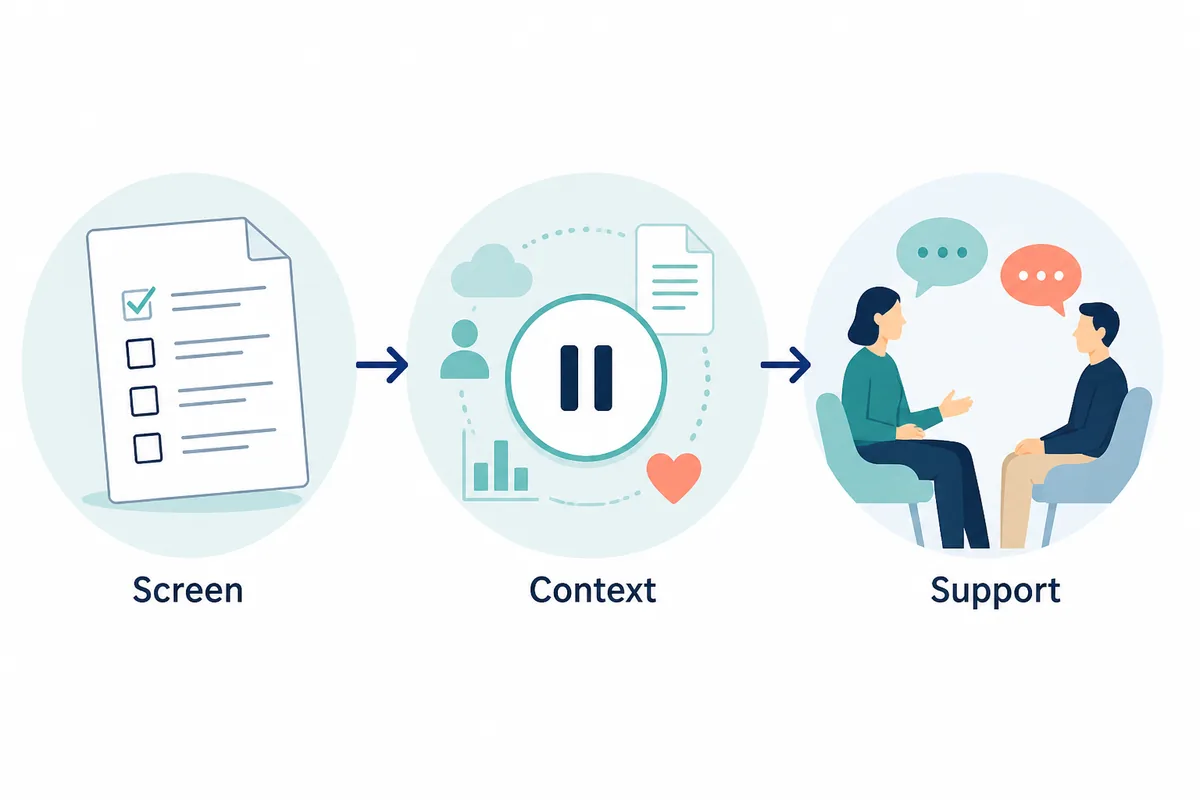
A personality disorder test found online is usually a screening questionnaire, not a diagnosis. It can help you organize repeated patterns, decide what questions to bring to a clinician, and find an appropriate next step. It cannot confirm a disorder from one score or tell you that another person has a personality disorder.
If you are evaluating a specific branded BPD questionnaire, our IDRlabs BPD test review applies the same screening-versus-assessment boundary to a named tool.
Personality-related symptoms can overlap with anxiety, depression, trauma, ADHD, bipolar disorder, substance use, grief, medical conditions, and ordinary responses to a stressful relationship or life event. A useful screen should therefore create better questions, not a new label to defend.
Safety first
If you are in immediate danger, thinking about suicide or self-harm, or cannot stay safe, use emergency services or a crisis resource in your country. Do not wait for an online personality disorder test to tell you what to do.
What Does “Personality Disorder Test” Usually Mean?
The phrase can refer to several different things:
- A screening questionnaire: a short set of questions that flags patterns worth discussing.
- A disorder-specific self-check: a questionnaire focused on one pattern, such as BPD-related symptoms.
- A clinical assessment: a structured conversation and history-taking process completed by a qualified mental health professional.
- A casual quiz: a low-context result designed for curiosity, which may not have a clear clinical basis.
These formats are not interchangeable. Before starting, check who created the questions, what the result is intended to measure, whether limitations are explained, and whether the page tells you what to do next. A serious screening page should not promise an “accurate diagnosis” from a few clicks.
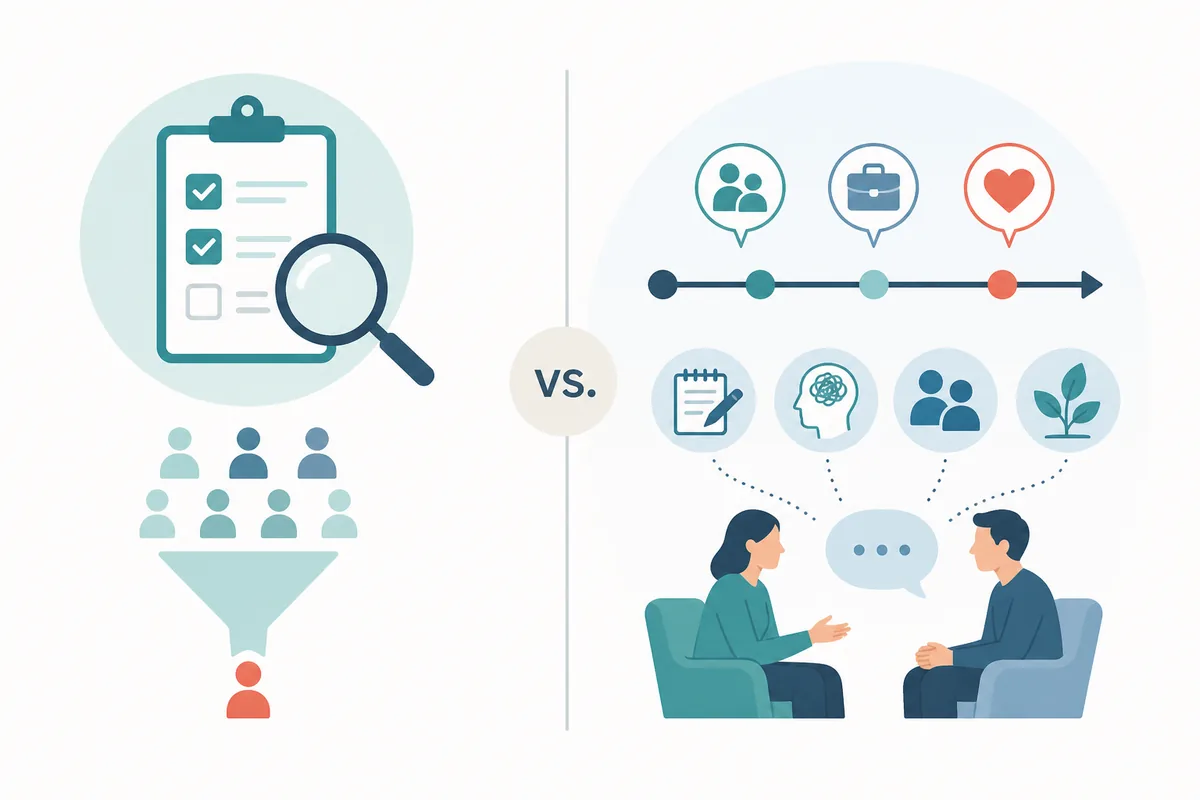
Online Screening vs Professional Assessment
| Question | Online screening | Professional assessment |
|---|---|---|
| Main purpose | Spot patterns and prepare next-step questions. | Understand symptoms, history, context, impairment, and safety. |
| Information used | Your answers at one point in time. | Interview, timeline, examples from more than one setting, and relevant history. |
| What it can say | “Some patterns may be worth exploring.” | Whether a diagnosis or another explanation is supported after evaluation. |
| What it cannot safely say | That one score proves a disorder or diagnoses someone else. | That a single conversation explains every part of your life without follow-up. |
What May Be Considered in a Professional Evaluation?
A clinician may look for a long-standing pattern that appears across situations and causes meaningful distress or difficulty in relationships, work, school, self-care, or safety. The exact process differs by country and clinician, but a careful evaluation commonly explores:
- Time and development: when the pattern began and how it has changed over time.
- Different settings: whether the experience appears only in one relationship or across family, friendships, work, school, and other contexts.
- Triggers and recovery: what happens before a reaction, how intense it becomes, and how long it takes to settle.
- Functioning and impairment: whether the pattern disrupts daily life, relationships, employment, education, or physical safety.
- Overlapping explanations: trauma, mood episodes, anxiety, attention difficulties, substance use, grief, medical factors, or another mental health condition.
- Current risk: self-harm thoughts, suicidal intent, violence risk, severe dissociation, or inability to stay safe.
The NHS overview of personality disorders explains that assessment involves understanding symptoms and how they affect a person’s life, rather than relying on a single online score. For BPD-specific background, the National Institute of Mental Health describes the condition as involving ongoing patterns in mood, behavior, self-image, and relationships.
How to Take an Online Personality Disorder Screen Safely
1. Choose a page that states its limits
Look for plain language explaining that screening is not diagnosis. Avoid pages that promise certainty, use frightening countdowns, or suggest that one label explains every symptom.
2. Answer for patterns, not your worst hour
Think about repeated experiences over time. One argument, one sleepless week, or one difficult breakup can make an answer feel urgent without showing a stable pattern.
3. Write down examples behind the answers
After finishing, note two or three concrete examples: what happened, what you felt, what you did, how long it lasted, and what happened afterward. Examples are more useful in a professional conversation than a bare percentage or label.
4. Compare the result with your actual goal
If you wanted to understand BPD-related patterns, use a BPD-specific resource rather than treating a broad personality disorder test as a general answer. Our BPD test options include quick, comprehensive, quiet, and teen-focused starting points, each with a reminder that screening is not diagnosis.
5. Plan a next step before you close the page
That step may be saving your notes, reading about another possible explanation, asking a trusted person for support, or booking an appointment. If the result raises safety concerns, contact urgent support rather than taking more quizzes.
How to Read Personality Disorder Test Results
A low or negative result
A low score does not prove that your distress is minor or that no support is needed. The questionnaire may not match your situation, or the main issue may be anxiety, depression, trauma, ADHD, bipolar symptoms, grief, burnout, or a relationship problem.
A high or positive result
A high score is a reason to slow down and seek context, not a reason to self-diagnose. Bring the result and the questions that felt most accurate to a qualified professional. Ask what other explanations should be considered and what evidence would help clarify the pattern.
An unclear or upsetting result
Stop if the questions make you feel overwhelmed, ashamed, or unsafe. You do not need to complete every quiz you find. A clinician, counselor, primary-care professional, or trusted support person can help you decide what information matters next.
Looking for a BPD-specific starting point?
This site focuses on BPD screening and education. Choose a test to reflect on BPD-related patterns, then use the result as a conversation starter rather than a diagnosis.
Explore BPD Test OptionsWhere BPD Fits in the Broader Picture
Borderline personality disorder is one condition people may have in mind when they search for a personality disorder test. BPD-related concerns can include intense emotional shifts, fear of abandonment, unstable relationships, identity disturbance, impulsive behavior, chronic emptiness, anger, self-harm risk, or stress-related disconnection. Those experiences can also overlap with other conditions, so a broader evaluation matters.
If your question is specifically “Do I have BPD?”, start with the Do I Have BPD self-check guide rather than trying to use a generic personality disorder test as a final answer. If you want to compare screening options and professional diagnosis, read the complete BPD tests guide. If you are unsure whether the pattern fits BPD or another condition, the BPD vs other conditions guide can help you organize questions for a clinician.
For people looking for a test for narcissistic, antisocial, avoidant, or another specific personality disorder, avoid diagnosing yourself or someone else from a short online quiz. Use the question as a prompt to seek appropriate professional information instead of treating a related keyword as proof.
FAQ
Is there one personality disorder test for every disorder?
No. Different questionnaires may focus on different symptoms or conditions, and a broad online screen cannot replace an evaluation that considers your history, context, functioning, and safety.
How do you take a personality disorder test safely?
Choose a screening page that explains its limits, answer based on repeated patterns, save concrete examples, and use the result to prepare questions for a qualified professional. Do not use a score to diagnose another person.
Can an online test diagnose a personality disorder?
No. An online test can suggest that further discussion may be useful, but it cannot confirm a disorder from one score. Diagnosis requires a qualified assessment and consideration of other explanations.
Is a BPD quiz the same as a personality disorder test?
Not exactly. “Quiz” may describe a casual or short self-check, while a BPD screening is intended to organize specific patterns. Neither is a diagnosis. If BPD is your concern, use a BPD-specific screen and read how to interpret it safely.
What should I do after a high personality disorder test result?
Write down the questions that matched, collect a few real examples, and discuss them with a licensed mental health professional. Seek urgent help immediately if the result connects with suicidal intent, self-harm risk, or inability to stay safe.
Can I use a personality disorder test to check whether someone else has a disorder?
No. A test cannot diagnose another person, and labeling someone from a relationship conflict can increase risk. Focus on your own safety, boundaries, and support, and seek professional advice when the relationship is harmful or frightening.
Sources and further reading
- NHS: Personality disorder overview — general assessment and support context.
- National Institute of Mental Health: Borderline personality disorder — BPD symptoms, treatment, and help-seeking context.
- NICE guideline CG78 — professional guidance for borderline personality disorder care.
- 988 Suicide & Crisis Lifeline — U.S. crisis support for people who need immediate help.
Medical Disclaimer
This article is for educational purposes only and cannot diagnose, treat, or replace professional mental health care. If you are in immediate danger, call emergency services or a local crisis hotline now. See our medical disclaimer for more information.