BPD ultrasound meaning usually refers to biparietal diameter, a fetal head measurement taken during an ultrasound. It estimates the distance across the baby’s skull at a standard view. In pregnancy, BPD is one part of fetal biometry—not a diagnosis, a guaranteed due-date calculator, or a stand-alone answer about growth.
The abbreviation can be confusing on a website about mental health because BPD may also mean borderline personality disorder. In an ultrasound report, however, BPD almost always means biparietal diameter. This guide explains the term, how it relates to HC, AC, and FL, and what to ask if a report leaves you worried.
Short answer
In pregnancy, BPD means biparietal diameter: the width of the fetal head measured on ultrasound. A clinician interprets it with gestational age, the measurement chart, head shape, other fetal measurements, and the growth pattern over time.
Table of Contents
BPD Ultrasound Meaning on a Pregnancy Report
Biparietal diameter is a measurement across the fetal skull. During the scan, the sonographer looks for a standard cross-sectional view of the head and places measurement points according to the examination protocol. The result is usually reported in millimeters and compared with a reference chart for the pregnancy’s gestational age.
BPD is useful because head size contributes to the overall picture of fetal growth. It is not the same as brain development, intelligence, or a prediction of how a child will look. It also does not describe the mother’s health by itself. The number is a measurement, and its meaning depends on how it was obtained and what the rest of the scan shows.
The word “normal” can be misleading when it is attached to one measurement. Ultrasound estimates have limits, babies grow at different rates, and the skull is not perfectly round. A clinician may consider another head measurement more informative when the shape makes BPD less representative. That is why reports often include several measurements instead of asking one number to answer every question.
BPD, HC, AC, and FL: What Each Measurement Describes
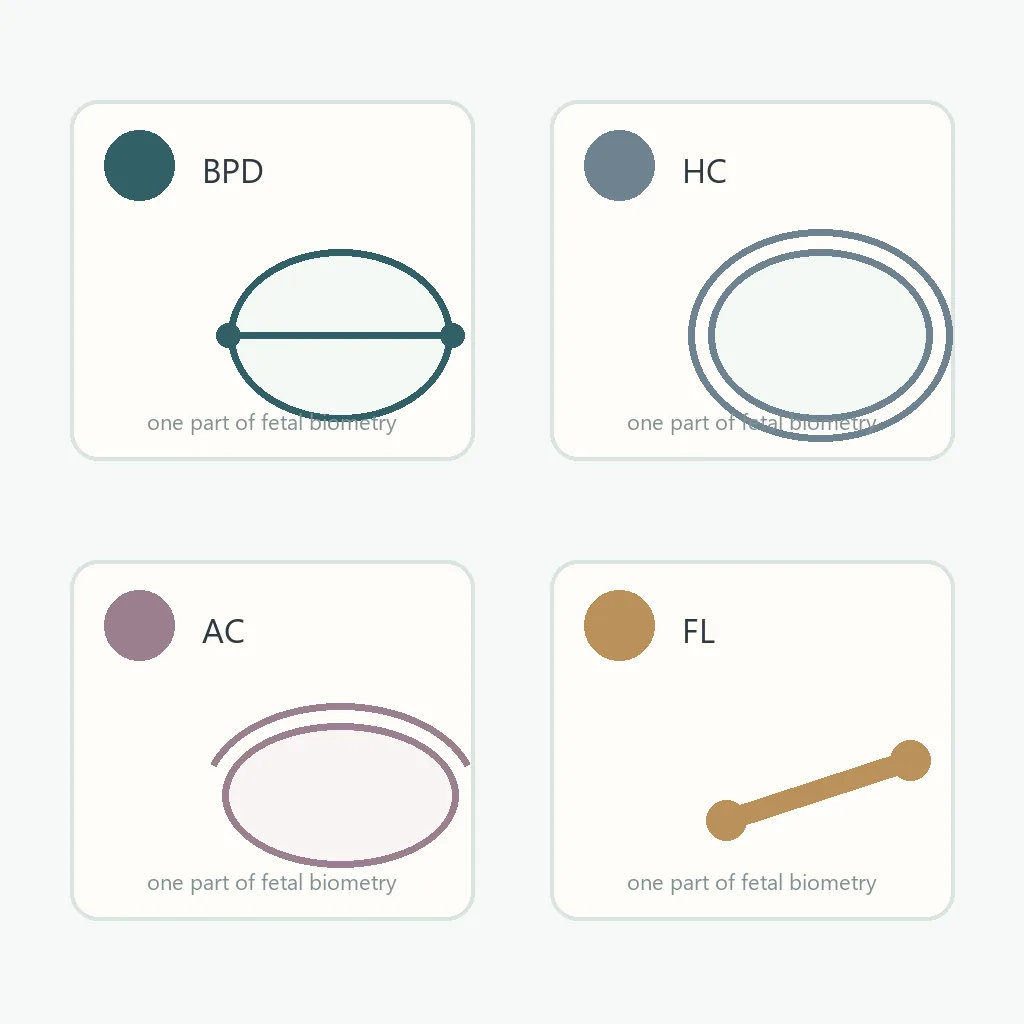
People searching for bpd means in pregnancy often see several abbreviations together. These measurements are related, but they are not interchangeable. The table below is a plain-language orientation, not a substitute for the interpretation section of your report.
| Abbreviation | Plain-language meaning | Why it may be included |
|---|---|---|
| BPD | Biparietal diameter, or the width of the fetal head in a standard view. | Contributes to fetal biometry and may help estimate size when the measurement view is reliable. |
| HC | Head circumference, a measurement around the fetal head. | Provides another way to describe head size, especially when head shape affects a width measurement. |
| AC | Abdominal circumference. | Helps assess overall growth and is considered alongside the head and long-bone measurements. |
| FL | Femur length, the length of the fetal thigh bone. | Offers a long-bone growth measure and helps complete the fetal biometry picture. |
That is why FL meaning in pregnancy is usually “femur length,” not another way to calculate BPD. A report may show an estimated fetal weight based on a combination of measurements, but the estimate has its own uncertainty. Ask which measurements were used and whether the clinician is concerned about a trend rather than focusing on a single abbreviation.
How to Read a BPD Number Safely
If your report lists BPD, start with the units and the gestational age used for comparison. Then look for the reference chart, percentile, or summary comment. The same millimeter value can have a different meaning at different stages of pregnancy, so the number should not be interpreted without the timing of the scan.
Searching for BPD ultrasound meaning can explain the abbreviation, but it cannot interpret an individual scan; the reference chart, scan quality, and other measurements provide that context.
Next, compare the context rather than performing a home diagnosis:
- Check the full set of measurements. BPD, HC, AC, and FL may tell a more useful story together than any one value.
- Notice whether the report mentions technique or head shape. A measurement can be less representative when the skull shape is unusually long, narrow, or broad.
- Look for a trend when scans are repeated. Clinicians often consider change over time, scan quality, and the reason for follow-up.
- Read the impression section. The radiologist or obstetric clinician’s summary usually carries more meaning than an isolated number copied from a portal.
A practical question to write down
“What does the BPD measurement mean together with the HC, AC, FL, gestational age, and the overall impression?” This invites an interpretation of the complete examination rather than a yes-or-no answer from one value.
What If BPD Is Smaller or Larger Than Expected?
A BPD that is described as smaller or larger than expected does not automatically mean there is a problem. Possible explanations include normal variation, the way the measurement plane was obtained, fetal position, head shape, differences between reference charts, uncertainty in gestational dating, or a growth pattern that needs to be checked with other findings.
Sometimes a clinician may recommend a repeat scan, additional measurements, Doppler assessment, or a review of the pregnancy dates. That recommendation is not the same as a diagnosis. It means the team wants enough information to decide whether the finding is stable, technical, isolated, or part of a broader pattern.
Avoid comparing your number with a friend’s, a social-media chart, or a generic online “normal range.” A reference range is tied to gestational age, the chart or standard used, the measurement method, and the clinical context. If the report uses words such as “follow-up,” “discordant,” “limited,” or “out of range,” contact the clinician or midwife who ordered the scan and ask what the next step is.
What to Ask at the Ultrasound Appointment
If you are unsure what is BPD in ultrasound, it is reasonable to ask for a plain-language explanation. Consider bringing these questions:
- Is the BPD measurement appropriate for the gestational age and the scan view?
- How does it compare with HC, AC, FL, and the estimated fetal weight?
- Does the fetal head shape affect how useful BPD is in this report?
- Is the finding isolated, or does it form a pattern with other measurements?
- Do you recommend another scan or any change in routine follow-up?
Bring the exact report wording, not only a screenshot of the number. If you have questions about dating, mention how the due date was established. Early dating information, later growth scans, and changes in measurements may be considered differently, so the care team needs the whole timeline.
Confused by the BPD abbreviation?
This site also uses BPD to mean borderline personality disorder in its screening resources. For mental-health information, start with the BPD information hub and check the context before interpreting an abbreviation.
FAQ About BPD Ultrasound Meaning
What does "BPD ultrasound meaning" refer to on the report?
In a pregnancy ultrasound report, "BPD ultrasound meaning" refers to biparietal diameter, the width of the fetal head measured in a standard plane. It is one part of fetal biometry and must be interpreted with gestational age, other measurements, scan quality, and the clinician’s impression.
Does BPD on an ultrasound mean borderline personality disorder?
No. In an obstetric ultrasound report, BPD usually means biparietal diameter. Borderline personality disorder is a different use of the same abbreviation and is relevant only in a mental-health context.
What does a low or high BPD mean?
It may reflect normal variation, measurement technique, fetal head shape, dating uncertainty, or a growth pattern that needs more context. One BPD value cannot diagnose a condition or predict an outcome by itself.
What does FL mean in a pregnancy scan?
FL usually means femur length, the measured length of the fetal thigh bone. It is considered alongside BPD, HC, AC, gestational age, and other findings rather than used as a replacement for BPD.
Can BPD determine the baby’s exact size or due date?
No. BPD can contribute to an estimate, but ultrasound measurements have uncertainty and are interpreted according to the timing of the scan and the dating method used for the pregnancy. Ask the clinician which information is being used for your care.
Should I worry if an online chart does not match my report?
Do not diagnose yourself from a generic chart. Different charts, gestational ages, measurement methods, and clinical situations can produce different comparisons. Use the report’s impression and ask the ordering clinician to explain the result.
Sources and Further Reading
Medical Disclaimer
This article provides general education only. It does not diagnose fetal growth, pregnancy complications, or any other medical condition. Do not change prenatal care based on an online explanation. If you are worried about a report, contact the healthcare professional who ordered or interpreted the scan.