An autism spectrum test is usually a screening questionnaire, not a diagnosis. It can help you organize observations about social communication, sensory experiences, routines, focused interests, and masking so you know what to discuss with a qualified professional. A result is most useful when it starts a careful conversation about your history, support needs, and other possible explanations.
The short answer
A high screening score does not prove autism, and a low score does not prove that autism is impossible. Screening tools are brief, self-reported snapshots. Diagnosis depends on developmental history, current functioning, clinical judgment, and whether the full pattern fits across settings.

Table of Contents
- What an autism spectrum test is
- What screening questionnaires cover
- How to use a screening result responsibly
- How to read a result
- Adult autism screening, masking, and burnout
- What a screen cannot tell you
- Preparing for professional assessment
- Autism screening and BPD questions
- Frequently asked questions
What Is an Autism Spectrum Test?
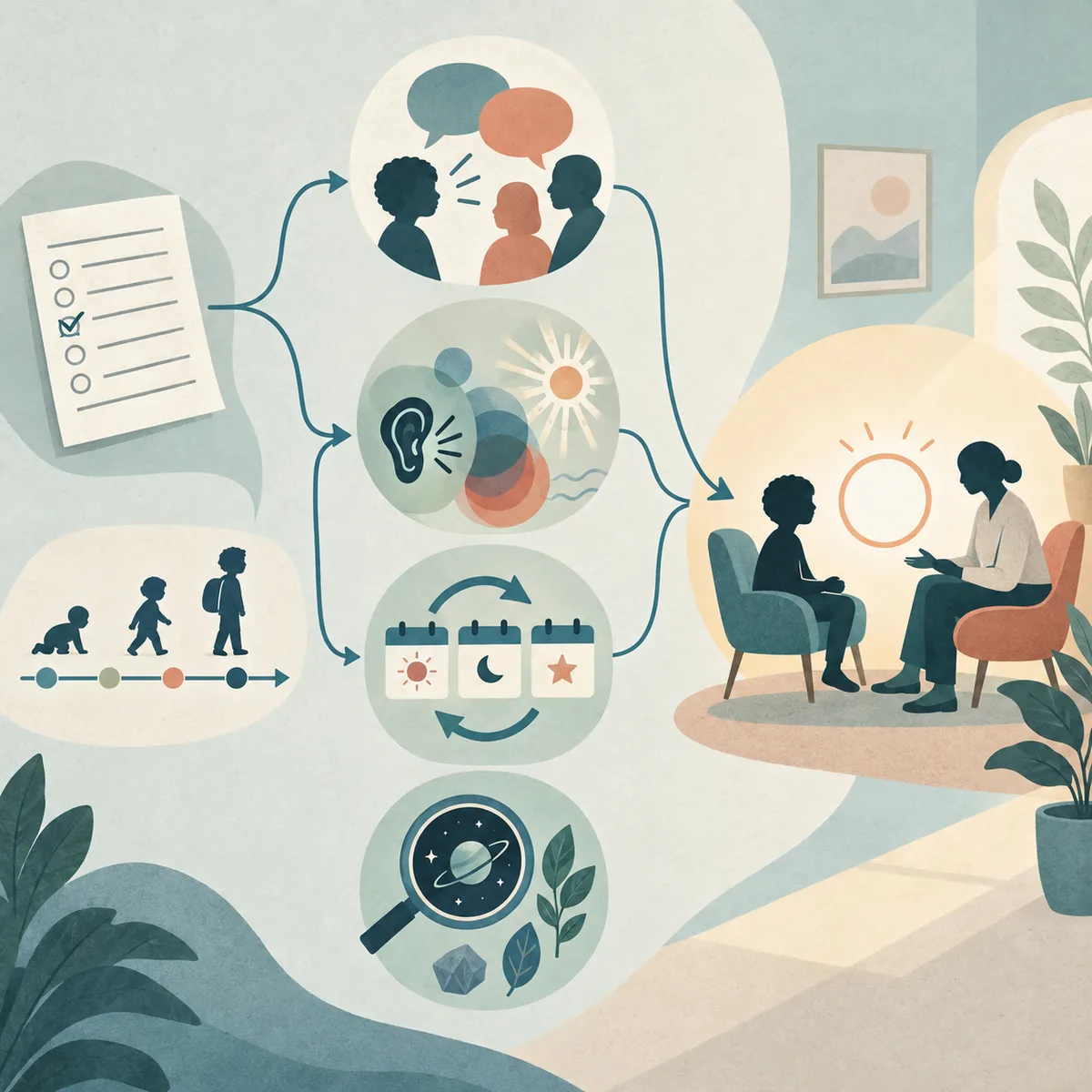
People use the phrase autism spectrum test to describe online quizzes, self-report questionnaires, and clinician-led screening forms. These tools ask about patterns such as reading social cues, handling changes, sensory input, repetitive movements, focused interests, and the effort required to appear comfortable in social situations. Some tools are designed for adults, some for children, and some are research instruments rather than consumer quizzes.
A screen is a starting point. It may show that your experiences are worth exploring, or it may help you explain why a previous label did not fully describe your daily life. It cannot identify a single cause. Anxiety, ADHD, trauma, depression, hearing differences, language differences, sleep problems, and stressful environments can affect answers. A responsible guide therefore explains both the possible signal and the uncertainty.
What Screening Questionnaires Usually Cover
Different questionnaires use different wording and cutoffs, but a useful screen usually samples several areas rather than asking about one memorable trait.
Social communication and reciprocity
Questions may ask whether conversation feels easier when expectations are explicit, whether you rehearse what to say, or whether you miss implied meanings. Consider frequency, effort, and impact. Being shy, preferring written communication, or having one awkward interaction does not establish an autism pattern.
Sensory processing and recovery
Noise, bright light, textures, smells, crowds, or touch may change your ability to think or stay regulated. Note the trigger, the intensity, how long recovery takes, and what helps. Sensitivity can also occur with migraine, anxiety, trauma, chronic pain, or other conditions, so context matters.
Need for predictability and repetitive patterns
Some people rely on routines, repeated movements, familiar routes, or advance notice of changes. Others become deeply absorbed in a topic or activity. The useful question is not whether you like schedules; it is whether changes and interruptions consistently affect functioning and whether the pattern has been present across development.
Focused interests, masking, and energy cost
A person may learn scripts, copy peers, or hide stimming in order to fit in. That effort can be followed by shutdown, exhaustion, or burnout. A screen cannot measure masking perfectly, so write down what happens before, during, and after social demands instead of answering only from your outward performance.
How to Use an Autism Spectrum Test Responsibly
- Answer from a typical pattern. Think about ordinary weeks, not only your best day or a crisis. If your answers change across settings, note why.
- Record examples. Write what happened, the trigger, the support you needed, and the recovery time. Examples are more useful than a score alone.
- Check the tool's purpose. Look for the intended age group, language, scoring explanation, and whether the questionnaire is a screen or a validated clinical instrument.
- Keep the result private and provisional. Do not post identifiable answers publicly or treat a cutoff as a label. Use the result to decide what questions to bring to a clinician.
- Consider safety and access. If distress, self-harm thoughts, abuse, or inability to function is present, seek timely help rather than waiting for an online test to settle the question.
How to Read an Autism Spectrum Test Result
Scores are not interchangeable across tools. A cutoff is a decision aid chosen for a particular questionnaire and population, not a universal boundary between autistic and non-autistic people. Use the result as one piece of evidence and ask whether the underlying examples are consistent.
| Result pattern | A careful interpretation | Useful next question |
|---|---|---|
| Higher than the tool's suggested range | Traits may deserve a fuller conversation, especially when they began early and affect daily life. This is not confirmation. | Which examples are lifelong, and what support reduces the impact? |
| Near the cutoff | Small wording, context, language, and mood differences can change a score. A timeline may be more informative than retaking the same quiz. | What happens across home, work, school, and relationships? |
| Lower than expected | A short screen may miss masking, learned strategies, or an uneven profile. A low score does not erase real support needs. | What difficulties remain even when the questionnaire score is low? |
Adult Autism Screening, Masking, and Burnout
Adults often seek an adult autism screening after years of feeling out of step, exhausted by social performance, or overwhelmed by sensory and routine changes. A person may have strong grades, a job, a partner, or a practiced social script and still need an autism-informed assessment. Functioning in one setting does not reveal the energy cost of maintaining that performance.
Prepare examples from more than one life stage. Childhood reports, family observations, old messages, school notes, and memories of play or friendships can help when available. If childhood information is missing, say so; missing records do not automatically rule out an assessment. The goal is a balanced history, not a story edited to fit a desired label.
What an Autism Spectrum Test Cannot Tell You
- It cannot diagnose autism, rule out another condition, or determine whether two conditions are present together.
- It cannot measure your intelligence, character, empathy, or value as a person.
- It cannot decide which accommodation, therapy, medication, or crisis plan is right for you.
- It cannot replace a safety assessment when there is self-harm risk, suicidal thinking, abuse, or severe functional decline.
Be cautious with sites that promise certainty, sell a diagnosis from a single score, or hide how questions and data are handled. A free autism test can be a private reflection tool, but free does not mean validated, and paid does not automatically mean clinically appropriate.
Preparing for a Professional Autism Assessment
Bring a one-page timeline instead of trying to remember everything in the appointment. Include early communication and play, friendships, sensory patterns, routines, focused interests, school or work demands, masking, burnout, and the supports that have helped. List previous diagnoses and treatments without assuming they were right or wrong.
A practical appointment checklist
- Write two or three concrete examples for each domain: social communication, sensory experience, repetition or sameness, and focused interests.
- Describe what changes when you are rested, overloaded, alone, with trusted people, or in a new environment.
- Bring questions about the assessor's training, the assessment steps, privacy, cost, wait time, and what feedback will include.
- Ask for recommendations that address support needs even if the final diagnosis remains uncertain.
Autism Screening and BPD Questions
Some people search for an autism spectrum test after receiving a BPD label or noticing overlap in emotional distress, rejection sensitivity, shutdowns, or relationship strain. Autism and BPD can co-occur, and either can be confused with trauma, ADHD, anxiety, or depression. A standalone autism screen cannot settle that differential question.
For a direct comparison of developmental patterns, emotional timing, sensory experiences, and professional evaluation, read our guide to autism vs BPD. Use this page for the separate question of what an autism screening questionnaire means and how to prepare for an assessment.
Need a structured BPD starting point?
Our BPD screens are educational and do not diagnose autism or any other condition.
View BPD screening optionsFAQ About Autism Spectrum Tests
Is an autism spectrum test the same as an autism diagnosis?
No. A screen samples traits and suggests whether a fuller conversation may help. Diagnosis requires a qualified assessment that considers development, current function, context, and alternatives.
What is the best autism screening questionnaire?
There is no single best questionnaire for every person. The appropriate tool depends on age, language, purpose, and the assessor's process. Ask how a tool was validated and how the result will be used.
Can I take a free autism test online?
You can find free self-report screens online, but read the privacy policy and purpose statement first. Treat the result as provisional and bring useful examples to a professional rather than sharing identifying details publicly.
Can an autism test miss someone who masks?
Yes. Learned scripts and strong performance can make a short questionnaire less representative. Describe the effort, exhaustion, shutdowns, and support you need, not only what other people see.
Can an autism screen tell me whether I have BPD?
No. Autism and BPD require different clinical questions, and overlap can also come from trauma, ADHD, mood disorders, or anxiety. Use the relevant screening result as one discussion point.
When should I seek help urgently?
Seek timely local help if you may harm yourself or someone else, cannot stay safe, face abuse, or are rapidly losing the ability to manage basic needs. An online screen should never delay emergency or crisis support.
Sources and Further Reading
Medical Disclaimer
This page provides general education, not diagnosis or individualized treatment. If you may harm yourself or someone else, cannot stay safe, or face immediate danger, contact local emergency services. In the United States, call or text 988.